Tag Archives: Writing

Back to School Blog Tour 2025 Day 5 – Jeff Boldt

Standard

Welcome to Day 5 of the 2025 Back to School Blog Tour. On our final day, I’d like to introduce you to a fabulous, children’s poet, Jeff Boldt.  With a background of teaching English in Shanghai for twenty years, he employs his humor and English literature knowledge into his poetry. He grew up in Texas immersing himself in books as a kid. He has been published in the Humor Times, the e-edition of the Orlando Sentinel, and in Doug Weller’s book, Six Word Wonders. I had the opportunity to review his children’s poetry book, It’s Raining Bats and Frogs and ask Jeff all about his inspirations, writing routines, and about his future projects.

Jeff Boldt is the author of the children’s poetry book It’s Raining Bats and Frogs.

What made you want to become an author?

Jeff Boldt: When I was young, I was immersed in books – they were such a big part of my life. Whenever I didn’t want to be in my own world, I would just go to Narnia or Oz or Wonderland instead. But books were more than a form of escape, they also challenged me intellectually and creatively. They had such a profound influence on my sense of self and my place in the world. Because of this, I wanted to be able to share that same experience with others. 

  • Who were your inspirations on your writing journey?

Jeff Boldt: Shel Silverstein, more than anyone, has had an impact on my writing. And not just on my style but on the way I think about writing as well. His work was always so funny and so brilliantly realized. I couldn’t believe that there were entire books filled with ridiculously hilarious and nonsensical things – like “Carrots” and “Everything on It” and “Snowball”. So much of school (and learning) to me was serious and boring and safe – and I thought that was what awaited me in the “real world”. Writers like Silverstein and Dahl and Carroll showed me a completely different way.

  • Do you have a writing routine? If so, please explain.

Jeff Boldt: I have never been good at schedules and structure, but I do make time for writing. I join writing clubs, take online classes (Oxford and UC San Diego), and generally push myself to do things that will challenge me and get me writing more. In other words, I don’t have a writing routine, per se, but I do make it a priority. Along those lines, I am applying to MFA programs right now because I want to pursue writing full-time.

  • For your featured book, how did you get the ideas to write it?

Jeff Boldt: Many of the ideas for my poems come from everyday life (work, spending time with my daughters, going out to eat, etc.). For example, the poem “If” came to mind after walking up some stairs to get to my office. The line goes like this: “If I took a set of stairs / and they led to nowhere / how far would I go / before I would know?” Reading it now, though, it’s hard not to see Pablo Neruda’s influence. Back in university, I used to carry The Book of Questions around with me wherever I went. It’s such a great little book. If you’re interested in philosophy and the absurd, I highly recommend it.

  • What writing projects are you working on right now?

Jeff Boldt: I’ve been tinkering mostly with picture book manuscripts lately (but also writing poems whenever I can). As for the picture books, I have a vowel series and I’ve completed manuscripts for e, o, and u. The u story actually appears as a poem in my latest book. It’s called “The Cnrious Case of the Lowercase u” and it’s a humorous rhyme about two letters, y and a, who can’t seem to find their missing friend.

Book Review

It’s Raining Bats and Frogs by Jeff Boldt is a marvelous children’s poetry book that reminds me of the humorous poetry of Jack Pelutsky. This collection of poems sparks the imagination as it described dressed up dinosaurs, dancing with potatoes in the moonlight, and ridiculous rhymes to recite. It’s a riot of humorous word salad as you read each poem making it a great read-aloud. It had me laughing, remembering when humor was much more simple as a kid.
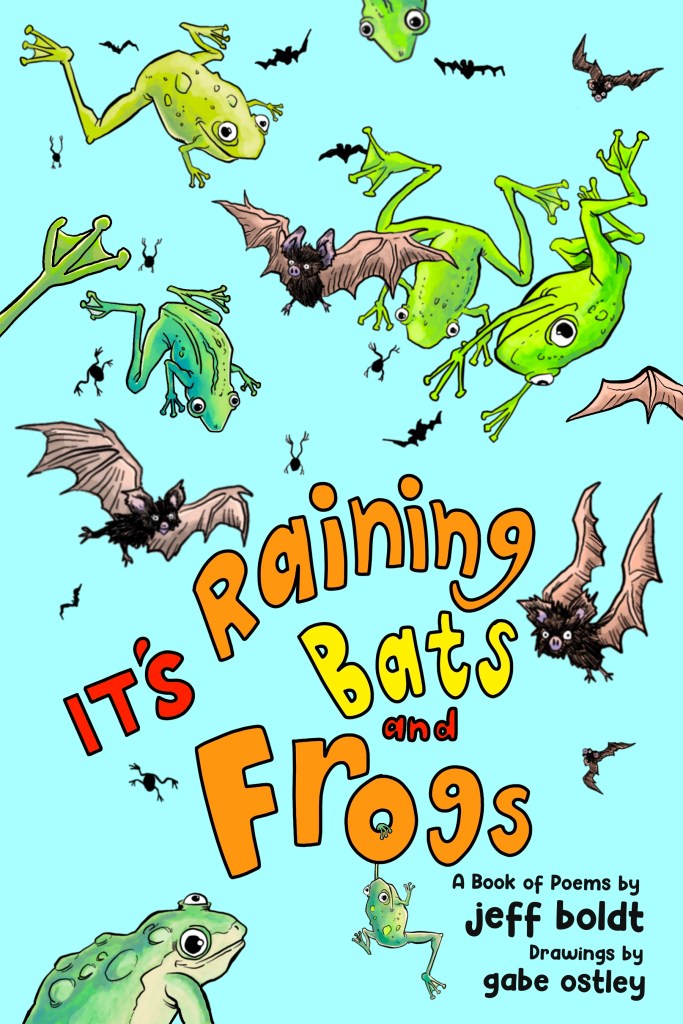
The illustrations are beautiful. Black and white pencil drawings bring the imagery of the poetry to life. Sometimes the cartoon renditions would make me burst out with giggles. The pictures definitely touched my inner child.

I loved Jeff Bodlt’s silly and mischievous mind that thought up these poems. They remind me of the children’s poems by Jack Prelutsky that wrote “Homework, Oh Homework”. I used to read-aloud his book during Poetry Month. I appreciate the use of humor to help kids connect with poetry. These poems do the job nicely. There is a lot of read-loud chanting and word play that will spark the creative side of any child.

I used to do a poetry collage project as a book report each year during poetry month. I would have loved to place this in my class library for my students to read and use for that project. In fact, I’ll place a link below where you can find it now on Teachers Pay Teachers.com.

I haven’t laughed so hard in a long time. These poems are a joy to share and to read out-loud. They will have whole families and classrooms laughing together. Perfect for read-aloud at home or any classroom.

It’s Raining Bats and Frogs is available on Amazon.com and is a Kindle Unlimited title.

For more information on Jeff Boldt, visit his website at: https://jeffboldt.com/.

Thanks for following along with the Back to School Blog tour for 2025. This will conclude the blog tour event for this year. Please show some love to the featured authors and check out their websites, look over their books, and consider your purchasing power when choosing an Indie author. They are so often overlooked for libraries and schools, but really can give new perspective, POVs and protagonists that speak to so many children.

As promised, here is the link to the poetry book report project available on Teachers Pay Teachers. I developed it over the years, making it a poetry collage and memorization project, mostly during Poetry month in March. But it can be done all year long. I wrote and developed it myself.

Thanks for stopping by all week. The Back to School Blog Tour will return next year. For more information on sign-ups, check out the Back to School Blog Tour page.

This is Mrs. turner, signing-off. Until next year, keep reading and writing!

-Mrs. Turner

Back to School Blog Tour 2025 Day 4 – Tomeko Brown

Standard

Welcome to Day 4 of the 2025 Back to School Blog Tour. Today’s featured author is Tomeko Brown, author of the children’s early chapter book, An Instrument for Florenda.  I reviewed her book a few months ago, and was happy to get the opportunity to interview her for this Back to School event.

Tomeko Brown has a background in education and health care. This unique perspective gives her an insight to the emotional, social and academic challenges kids face each day. Combining her own love for playing the clarinet and her son’s creative feedback, An Instrument for Florenda grew from a writing project into a book. I had the opportunity to hear more about Tomeko’s inspirations as an author, her creative process, and what she has planned for future books.

Tomeko Brown is the author of the early chapter book, An Instrument for Florenda.

What made you want to become an author?

Tomeko Brown: I have always enjoyed writing. When I was growing up, I liked writing poems and songs. I remember writing a poem for my ninth-grade home economics teacher when she retired. The poem was framed and given to her by the FHA (Future Homemakers of America). I still have the thank-you card she gave me. It really encouraged me.

In college, I studied education and instructional design. That gave me the chance to write and create training materials. But after working with kids in the public school system, I wanted to find a way to encourage them outside of school.  What better way than through stories?

I have always believed books can make a big difference—especially for kids. They can inspire dreams and help during tough times. I used to read a lot to my own children when they were little, and I remember how happy they were when I read their favorite book(s). Even how happy I was when I read my favorite book, Charlotte’s Web, growing up. That joy is what made me want to become an author.

  • Who were your inspirations on your writing journey?

Tomeko Brown: My family and friends are my greatest inspiration. They travel with me to book events, take pictures, cheer me on, and are always ready to celebrate every milestone.

Outside of my family and friends, I try to surround myself with other writers. Becoming a member of the Society of Children’s Book Writers and Illustrators (SCBWI) has helped me do that. It gives me a place to connect with others, support each other through the submission process, and celebrate the wins together.

  • Do you have a writing routine? If so, please explain.

Tomeko Brown: That’s a great question. Honestly, ideas can come to me at any time, on any day. I laugh because there have been times when I’ve woken up at 3:00 AM with an idea or something to add to a story I’m working on.

I write things down on anything I can find—scraps of paper, sticky notes, the Notes App on my iPhone, or even a napkin! That’s where the fun starts.

Remember in school when the teacher gave you a graphic organizer to help plan your writing? I still use that same idea today to organize my thoughts and help build my stories.

  • For your featured book, how did you get the ideas to write it?

Tomeko Brown: The idea for the book came from my time playing the clarinet. I’ve always loved the arts—drawing, crafting, and music. My son, Chris, also played the clarinet, and his input and experiences were so valuable in shaping this story. I’m even planning to start playing the clarinet again.

Our experiences of being in a school band and learning to play an instrument helped turn this into a story that would inspire kids to follow their dreams and believe they can reach them.

  • What writing projects are you working on right now?

Tomeko Brown: Right now, I’m working on a couple of different projects. I’m continuing to build my brand, Moving Notes Books TM, which includes both the first and second editions of An Instrument for Florenda. This early chapter book is more than just a story—it’s meant to help build confidence and encourage kids to go after their hopes and dreams.

In addition, I am getting ready to send a picture book manuscript to a small traditional publisher.

Book Blurb for An Instrument for Florenda

Florenda has always wanted to play in a band. Surrounded by the sounds of music in her small Louisiana town, she is thrilled when her school announces a new band class starting after summer break. But when a visit to the local music store with her mother reveals that the instrument she wants to play is beyond their budget, Florenda faces a tough challenge. Will she be able to play the instrument she’s dreamed of, or will her musical aspirations have to wait?

An Instrument for Florenda is available at Amazon.com and Barnesandnoble.com.

For a review of this book on this blog, link here.

For more information on the author, Tomeko Brown, please visit her website at:

https://tomekobrown.com.

Back to School Blog Tour 2025 Day 2 – Kenneth Haines

Standard

Welcome to Day 2 of the Back to School Blog Tour. Today, I’d like to introduce you to Kenneth Haines, a children’s fantasy author. Mr. Haines has written immersive children’s fantasy tales. Being known for his titles, Sea of Shadows and Whispering of the Sand, he builds worlds where eerie meets the heartfelt. I had a chance to ask him about his inspirations, writing journey, and plans for future books.

Kenneth Haines is the author of children’s fantasy novels.


1)    What made you want to become an author?

Kenneth Haines: I became a single father to three boys and two girls. Plus, I must have inherited it from my great, great Aunt Helen Keller.

2)    Who were your inspirations on your writing journey?

Kenneth Haines: My writing journey was inspired by my children growing up and things we did together. Plus, their struggles growing up and things I seen and done growing up. While my younger ones were in elementary school, I started writing short stories for them. So, I would read before bedtime to them and when they had sleepovers. After they all grew up, I continued reading to some of their friends. I still remember my stories. My youngest son mentioned that I should look into publishing ones I wrote and just had hidden away in a filing cabinet.

3)    Do you have a writing routine? If so, please explain.

Kenneth Haines: I take care of a parent with dementia. Since I have to be close by during Mom’s nap time, I found time to bring my stories to life especially when the weather doesn’t permit me to go outside.

4)    For your featured book, how did you get the ideas to write it?

Kenneth Haines: My books start with meeting people and finding out their inner strengths and have a unique name. Then at night while sleeping, it comes to me so vividly. I’m able to put it down on paper the next day. I also design my own covers for all my books.

5)    What writing projects are you working on right now?

Kenneth Haines: Jasey’s Secret: The World Beyond the Glass is my newest book. I am working on the second book right now. Jasey’s Secret is a heartwarming tale of wonder, courage, and the unbreakable spark of childhood imagination. It’s for anyone who has ever refused to let go of magic.

Jasey’s Secret: The World Beyond the Glass is a children’s fantasy that takes the reader beyond their imagination into a fantastic, eerie world. Jasey’s discovery of her inner magic builds into a courageous story as she refuses to let go of her gift. This heartwarming tale will inspire any child to pursue their own journey of discovery and look to themselves for the magic inside.

Jasey’s Secret: The World Beyond the Glass and other Kenneth Haines books are available on Amazon.com, Barnes and Noble.com, and the Google Book Store.

For more information for books by Kenneth Haines, please visit his website at: HERE!

Thanks for checking in for our featured author today. Check back tomorrow for a new featured book review.

-Tiffany Turner

Head Writer/Editor

Indie Children’s Authors Connection Blog

Book Review: “An Instrument for Florenda” by Tomeko Brown

Standard
“An Instrument for Florenda” by Tomeko Brown is available on Amazon.com and BarnesandNoble.com.

As summer is starting to wind down, I wanted to let you all know about a wonderful story with heart. “An Instrument for Florenda” by Tomeko Brown takes you into a small town in Louisanna through the eyes of Florenda. Her dream is to play the clarinet. Filled with challenges and life lessons, this chapter book will inspire and validate any reader to follow their dreams.

Florenda is an eleven-year old living in a small Louisiana town. When her school announces a new band class starting during the summer break, she is excited to take advantage of the opportunity. But when she visits the local music store with her mother, she finds out the instrument she longs to play is out of her budget. Will she find a way to acquire an instrument before the new class starts? Can she make her family proud when confronted with how difficult learning to play an instrument can be?

I really did enjoy this chapter book as a choir kid. I knew a lot of band kids in school too, and it really does give you an insight into what it’s like to begin that journey. It also really shows the struggles of Florenda’s family in making the dream come true, and how she doesn’t want to disappoint them when she finds learning an instrument to be harder than she realizes. It’s a great journey in finding the strength inside to fulfill your dreams, and how family support really does make dreams come true.

This is a great book with an African-American protagonist that reaches into your soul and takes you on a band kid’s journey. I can see this as a great gift for a child starting band class, teacher’s needing to add to their class library, or as a reading circle novel study book. Tomeko Brown does a wonderful job pulling you into the world of her characters and showing the struggles of a Louisanna family making musical dreams come true. A few black and white pencil illustrations add drama to the story. The support and love comes through strongly in the actions and dialogue of the book. I would recommend it as a great addition to any home or school library.

“An Instrument for Florenda” is available on Amazon.com and Barnes and Noble.com.

And just an FYI to add, the 2025 Back to School Blog tour will be starting Labor Day weekend. It will include author interviews and book reviews for the latest Indie children’s books. If you’re an author and would like to apply, please fill out the form here.

Tiffany Turner has 15-Minute Play, “Meet in the Park” chosen for 2025 UpStage Napa Valley PlayFest

Standard

I am proud to announce that I have had my 15-Minute Play, “Meet in the Park” chosen for the upcoming 2025 UpStage Napa Valley PlayFest. I am just absolutely over the moon about being chosen this year. I moved to Calistoga a few years ago, and found out about a local playwright festival hosted by the local theater group, UpStage Napa Valley. So, being locked down and in a new town, I thought I’d give it a try to enter. I have been trying each year, around the early spring. I’ve been making it a regular writing project to write a new play following the theme of the annual festival. After three previous attempts, I finally was selected this year.

The one thing I’ve learned as a writer is not to give up. Every time you try to write, you learn and improve. Each new 15-minute play I worked on, I grew and learned more about the genre. I had written a play as a drama major in college. It seemed like the thing to do back then, and I attempted a one act play. I still have it, often looking back if I could do it again. I didn’t win that play contest, but I had learned a lot. This new play festival opened up the idea to try again at writing plays. I would like to thank UpStage Napa Valley for supplying this opportunity to aspiring playwrights like myself to go after that dream. I’ve expanded myself as a writer. Giving play writing a try again has been a great experience.

To me, writing a 15-minute play was similar to writing flash fiction. I’ve tried that particular genre though online contests too. For some reason, I seem to work well having a competition and deadline to work towards. I’ve found it’s been nothing but rewarding. Going down this playwright path, exploring my writing chops, and giving my all has been uplifting during these last few years. I wanted to see if I could create a play that would be able to touch someone, or everyone. I thank UpStage Napa Valley for this incredible honor, and I look forward to seeing the final production in October.

To add to this, my play will also have a staged-reading performance at the opening of the new Brannon Center in Calistoga on Oct. 4th. I am extremely thrilled by this announcement as well.

To all the aspiring writers and playwrights out there, just keep trying. Don’t give up. You have something special inside. With every writing project you create, you polish that sparkle within. Keep going. I want to hear your story, see your play, and so does everyone else.

UPDATE July 24, 2025:

Auditions will be starting soon for the PlayFest! If you live in the Napa Valley area and would like to try out for the festival shows, there are a variety of parts needed. My play, “Meet in the Park” needs three actors. Randall is a late 20s, early 30s male role. Claudette is along the same age, late 20s to early 30s, but they could cast a little older depending on people that come out for the audition. Mary-is an older woman, in her 60s, and mother to Randall. This is a great way to break into doing local theatre. The plays are no longer than 15 minutes, and you get a $100 stipend. Great to add to a resume!

Auditions are July 30th, 7pm -9pm at 1428 Spring St, St Helena, CA 94574.

Performance dates are on the weekends in October.

**IF you can’t make the date above, they are arranging appointment readings to meet your schedule.
Here is the information link on the UpStage Napa Valley website.

https://www.upstagenapavalley.org/auditions

For more information about the UpStage Napa Valley PlayFest 2025, please visit the link below.

Guest Post: 5 Tips to Help You Write Awesome Children’s Characters

Standard
Savannah Cordorva is a writer with the website, Reedsy.com.

Good characters are the key to any novel’s connection with its readers, and this is no different in children’s books; if anything, it’s truer. Think of iconic children’s books like Harry Potter, Matilda, or The Hunger Games —what do they have in common? Their characters are relatable, driven, and memorable.

Indeed, even the most fantastical books rely on human themes to resonate with readers. After all, it’s usually the way that characters interact with elements in the book that makes it interesting, rather than the elements themselves!

This is why, no matter what sort of children’s book you’re writing, it’s crucial to develop strong characters that will stay in your young readers’ hearts for generations. Master these tips and you’ll be well on your way.

1. Establish your character’s age and relevancy

Many popular children’s books are remembered for their cherished protagonists. However, there are a couple of elements that set the best apart from the rest: age and relevancy.

Specifically, the ideal formula for long-lasting characters is that they should be both a few years older than the target readers and experiencing similar real-life issues. Children love reading stories that they can relate and aspire to!

For example, Percy Jackson is twelve years old in Percy Jackson and The Lightning Thief, and attracts readers around ten years old. Of course, while Percy’s young fans won’t be discovering their mythical powers, they are growing up and will soon be entering new environments and making new friends — just like him.

As long as you explore human themes, feel free to give your characters the most fantastical plotlines you can think of. And if you want total control of your characters, consider self-publishing your children’s book! Linking your protagonist’s story to a real-life lesson is the bread and butter of character writing, but if this lesson is somewhat unconventional, the self-pub route could be your best shot at conveying it without compromise.

2. Build their drive and motivations

You’ve established your character’s age and relevancy. Great! The next step is to make sure your protagonist’s main goal — the essence of your story — is clear. Whether you’re writing a short story or a novel, it’s crucial to get this right. A story’s narrative arc will fizzle without motivation to propel things forward. And with children’s relatively short attention spans, they certainly won’t be giving precious attention to a lackluster plot.

This means another huge part of well-written children’s characters is that what they want or need drives the plot. Imagine how boring a story like Treasure Island would be if Jim Hawkins didn’t want to find Captain Flint’s treasure. And Watership Down wouldn’t be nearly as memorable without Hazel’s need to escape from the warren’s destruction. Once your character’s key motivation is established, the rest of their story should unfold with ease!

3. Put thought into their appearance

While a character’s internal thoughts are very important, that doesn’t mean their external characteristics deserve none of your time. Though personality is Priority One in terms of story, physical characteristics are often what make a first impression, in books and reality.

So while your protagonist’s appearance might not directly affect the plot, it can impact how supporting characters respond to them. And of course, if you’re writing a picture book, how the characters look will be a major part of the reader’s experience — and will likely contain visual clues about their personalities, emotions, and so on.

This is why, regardless of your artistic abilities, it’s worth sketching out your characters, from their hair color to their type of shoes. It doesn’t have to be Van Gogh-worthy, but having a concrete reference for your character’s appearance will make it easier to imagine — and therefore write out — more realistic scenes in your story.

This may be particularly helpful when it comes to dialogue. Another useful thing to consider is your character’s voice: What do they sound like? How do they interact differently with one character vs. another? Does their voice match their physicality, or present a comical contrast?

(If this sounds like a lot of details to organize — or if you’re looking to go even more in-depth — try checking out some character profile templates to help, or perhaps just a few character-building questions to get the ball rolling.)

4. Choose meaningful, memorable names

Well-named characters are sure to stick in readers’ heads. It sounds simple, but giving a character a name that reflects their key traits will tie everything together — and tell readers what to expect!

A classic example of this is Harry Potter’s Remus Lupin: “Remus” nods to the Roman myth about the twins Romulus and Remus who were raised by a wolf, while Lupin is derived from the Latin for “wolf”. So — spoiler alert — it’s no surprise that Remus Lupin turned out to be a werewolf, with a name meaning “Wolf Wolf”. Another perfect example of this is the much-loved Miss Honey in Roald Dahl’s Matilda, who is adored for her sweetness.

Though a name might seem a small feature, plenty of creativity goes into naming popular children’s characters! Whether your characters’ names are obscure linguistic references or common synonyms, make sure they’re fun to learn and impossible to forget.

5. Make character conversations believable

Going back to dialogue for our final point, many children’s writers are tempted to write their dialogue as they think children speak. But unless you’re a preschool teacher or a parent, try to avoid presuming anything!

Indeed, it’s worth familiarizing yourself with your target audience to facilitate more believable conversations. Good ways to research might be volunteering at your local school or working at a library. Bonus points if you have friends and family with children that you can ask to proofread your book. Their endorsement is a major signifier that you’re on the way to helping your target audience feel understood and represented.

Of course, every child is different, with their own personalities, opinions, mannerisms, and quirks. Keep in mind that your characters should progress and change, but dispositions — for example, a sharp sense of humor or joyful attitude — aren’t usually as fluid. A good rule of thumb is to figure out the essential traits your character has and stick with them. With this in mind, your characters are sure to instill readers with plenty of intrigue and love.


Savannah Cordova is a writer with Reedsy, a marketplace that connects self-publishing authors with the world’s best editors, designers, and marketers. In her spare time, Savannah enjoys reading fiction (especially YA fantasy, and picture books to her niece and nephew!) and writing short stories.

Tiffany Turner was the editor on this post.

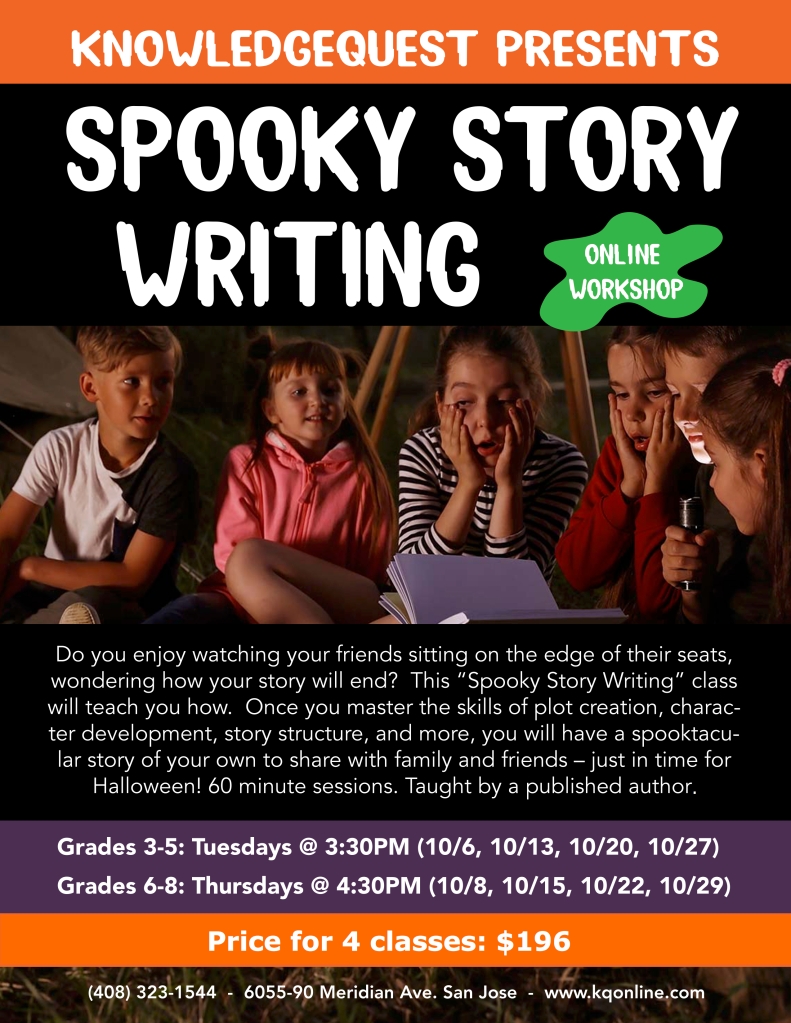
Tiffany Turner To Teach Online Spooky Story Writing Workshop

Standard

It’s getting near that spooky time of year. After over 15 years of teaching a spooky story workshop to my students, I’m offering it for the first time online. Bring Halloween indoors in an academic way, and keep this season spooky, fun and safe! It will be available two ways.

1) This first way to sign up for this workshop is as a full online in-person experience taught by myself live on Zoom. It will be available through the tutoring center called Knowledge Quest. I’ve worked there now for 3 years tutoring students in person and in local schools before the pandemic.

Now, the opportunity to learn from myself, a published author and certified teacher, is through Knowledge Quest. It starts on Oct. 5 through Oct. 29. There are two sessions, one for grades 3-5 and the other for grades 6-8. Each session will have one hour a week for four sessions. Kids will have an hour of instruction and will be walked through activities and given assignments to continue writing between sessions.

**Some at home support, such as looking over the story and doing feedback with your child, will be required.

I’ve taught and developed this spooky story unit over the years and I have put up some parts of it FREE to do through my website. But this is the full unit, developed by me, and available only this upcoming month of October. By the end of the sessions, all the students will have written their own stories that they can share on Halloween night. They will learn character development, create a plot with problem/solution structure, study the spooky genre, and have a lot of fun! They’ll have a chance to unlock the creativity within them.

**Note times are Pacific Daylight Time since I’ll be teaching the workshop live through Zoom. Sign-ups for the live Zoom instructional spooky workshop is through Knowledge Quest.

Find out more and REGISTER HERE!

2) The second way to take the workshop, especially if it would be difficult to in your time zone, is to sign up for my online writing school course. It’s the first course available, and I plan to develop more through the next several months. I’ve decided to develop the spooky story writing workshop first since the basic posts on the blog are so popular, and my students loved it as their favorite story during the school year.

Here is the blurb from my writing school “Keep On Writing”:

Ready to have some fun writing? Here’s a course to help children love writing and enjoy it. I often found children didn’t get to enjoy the writing projects assigned when I was a teacher. So, I developed an, exciting “Spooky Story” writing project for the month of October that I taught for over fifteen years in my classroom. Now, your child can experience the joy of writing and using their imagination.

Taught through a Writing Workshop format, I go over all the steps of writing, prewriting, drafting, revision and proofreading and creating a final draft. Each lesson includes mini-lessons on the craft of writing including organizing ideas through graph organizers, writing dialogue, “Show, Don’t Tell”, plot creation, character creation and conflict, and problem/solution story structure.

Write your own Spooky Story in either a live workshop with Mrs. Turner or in her online writing school. Get spooky and stay safe this Halloween! Use your imagination and write!

When your child finishes the course, they will have a fantastic story of their own creation to share with family and friends. As they go through the writing process, they are asked to work with a family member or guardian with the writing process in which they learn to gain feedback on their writing and make changes. Anyone in the family or through Zoom can fulfill this role making it a bonding activity with your child.

Whether this course is being used during the fall for a Halloween project or any time during the year to engage children in writing, or help adults write for children, it has always been a student and child favorite. I now present to you, the “Spooky Story” Writing Project to help bring the joys of writing to your child.

The online writing school course is $19.99.

LINK HERE TO FIND OUT MORE & REGISTER!

**Happy Halloween!

-Mrs. Turner

Coming Soon: Back to School Blog Tour 2020

Standard

BacktoSchoolBlogTour2020It’s almost here. The 8th Annual Back to School Blog Tour is ready to launch on Monday, Aug. 31. This year, there will be a line-up of authors and featured books to help support kids, parents and teachers during this challenging year. With changes in routine to going to school masked or online, kids and parents are facing different challenges than ever before. I’ve lined up a variety of authors and their books to help support creative learning, children’s literature and distance learning.
back2schoolbanner2020Here is the line-up of authors for this year:

  1. Casey Gale
  2. Karen Goeller
  3. Devin Martin
  4. Craig R. Hazen
  5. Thomasina M. D’Arezzo

Each author will be featured each day of the blog tour. Feel free to visit information about their blogs/websites and about their featured book. As an added treat, I will be giving away a $25 Amazon Gift Card through a Rafflecopter giveaway. Just visit the link to win all week, and the winner will be announced after the blog tour is over.

Come join all the fun and get to know some new, fabulous children’s authors!

The Back to School Blog Tour will be Monday, Aug. 31 through Friday, Sept. 4. Hosted here by the Indie Children’s Authors Connection.

***Follow my blog to get all of the posts emailed to you.

See you next Monday!

-Tiffany Turner

Interview with Daniel and Madison Davis

Standard

Dan _ Madi

Daniel and Madison Davis are the authors of the children’s poetry book, Melancholy Musings: Children’s Poetry for Life’s Darker Moments

With so much sad news and depressing events happening around us, there is nothing better than poetry to perk up your summer. I’ve found a fabulous father and daughter writing duo. Meet Daniel and Madison Davis. Dr. Daniel Davis is a sociology professor at San Diego State University. His daughter, Madi, loves art, writing and hip-hop dancing. They paired up during the Spring Shutdown to write poetry together to cheer themselves up and to share a positive literature experience with readers.

Their book, Melancholy Musings: Children’s Poetry for Life’s Darker Moments, presents children’s poetry to share and read to help with the stress and pain of growing up and other tragic events in life. I had a chance to ask Madi and Daniel about their writing adventure during this pandemic, and what they have in further store for us.

1) What is your favorite memory from reading as a child?

Madi: I’m still reading as a child! But I did feel happy when I finished the longest Harry Potter book. It was like 600 pages.

Daniel: I remember my mom signed me up for a summer reading challenge at the local library. I read as many kids books as I could, and don’t remember how many it was, but I ended up winning the challenge and felt pretty cool about it.

2) Who was your favorite author and how did they influence you?

Madi: J.K. Rowling is my favorite. I’ve read everything she’s written. They made me really eager to keep reading.

Daniel: For fun, probably Douglas Adams’ The Hitchhiker’s Guide to the Galaxy. I love that genre of zany British humor, always makes me laugh. More seriously, probably Peter Berger’s work on the social construction of reality, which helped me see the many ways that society is our own creation. 

3) Do you have a writing routine? Share what works for you.

Madi: I write whenever I feel like it, but if it’s for school I always finish a rough draft the first day, add to it the second day. If there’s a third day, I spend that one editing it. For Melancholy Musings, there were also some deadlines from my writing coach and Dad that helped keep us going.

Daniel: I try to set up a process for each project. Like for this one, I would brainstorm poem topics with Madi and have her come up with some rhyming word pairs and ideas. Then I might create a few lines another day and she would go over them and add some still another day. It was a back and forth approach. 

4) What subjects would you like to write about in future projects?

Madi: Most things fiction. I sort of hate non-fiction. I like writing stories with drama, suspense, and mystery.

Daniel: Probably non-fiction or journal articles. I’m a sociologist, so either research or materials students can use in sociology classes.

5) How was your current poetry book written?

Daniel: While we were apart, Madi and I shared a Google doc and would take turns talking on the phone and adding lines and poem ideas. Madi also had the idea of making all of the imagery from the same family and centered on the main little girl. As new poem ideas came along, the family of characters kept growing.

6) Why do you feel this was an important poetry collection to create?


Daniel: Children’s books and poems typically center on happy topics or fantasy, but difficult things happen to kids too. We thought it might be meaningful to create a set that parents could pull from to allow for discussions about these things with their kids. Ultimately pets pass away, families have to move or get divorced, loved ones get sick; it can be helpful to have opened up some of these conversations with kids in advance. It helps them understand that these things happen to everyone; they are part of life.

7) What message do you have for aspiring poets?


Madi: Just keep practicing! I could tell by the end, we had better poems than what we had first written.

Daniel: Brainstorm lots of ideas, take your time, have fun with it, and find a good website to help you think of rhyming words.

8) As a parent, why do you think working on a project like this during the pandemic helped you and your daughter cope?

Daniel: It gave us something to focus on other than all of the bad news that was happening every day. We also had little deadlines we self-imposed every Tuesday at noon. So, sticking to some kind of structure like that helped make sure we kept working on it, but also that we made time to FaceTime each other every week. It was nice to connect with her and hear her ideas and thoughts. I could tell some of the topics were easy for her to think of, like the death of a goldfish or getting lost in a crowd, which she had experienced before. But there were other topics that were more of a stretch, like imagining what it would be like to have an older sister go away to college or an aunt tired of hosting family for the holidays.

9) What suggestions do you have for parents trying to help their children through the COVID19 pandemic?

Daniel: It depends on the age of the kids, of course. With a tween, I try to keep her informed and aware of what’s going on, but she doesn’t need daily updates on virus numbers and such. She is careful about social distancing and understands it, but not getting to see her friends or have her fifth-grade promotion, missing summer trips and camp are certainly a disappointment. The pandemic will forever be a milestone of her generation’s collective memory, like 9-11 for the cohort before. But unlike 9-11, Covid-19 is such a prolonged tragedy. It’s hard to say what the long-term impacts will be.

But I think the best thing we can do is keep listening to our kids and giving them room to process. It’s an unprecedented situation, so it’s hard to give one-size-fits-all advice. Different kids will need different things. But, I think if we listen empathetically and ask lots of questions about how they feel, in most cases they can tell us what they need. We don’t have to guess.

10) What is writing to you in one sentence?

Madi: Writing is a hobby that I really like, especially writing surprising stories where a character might get hurt, go insane, or die all of a sudden. Not really horror, but things people don’t expect me to write.

Daniel: It’s a way to share ideas and inspiration with others, and possibly even a way to create a legacy that will outlive us.

Melancholy Musings Front CoverMelancholy Musings: Children’s Poetry for Life’s Darker Moments is a fantastic read-aloud to share with family to discuss times such as the pandemic or the other difficulties children face. Death of pets, life transitions, moving to a new place and others can be difficult events in a child’s life. This collection addresses these tough subjects along with others in a humorous and empathic poetic approach. It encourages families to have discussions together with poetry as the catalyst. Written as collaboration between a father and daughter during the Spring Pandemic Lockdown of 2020, these light-hearted poems will be a wonderful addition to any home library.

Book Trailer Link: https://www.youtube.com/watch?v=ro1xd9P1qKU&t

Melancholy Musings: Children’s Poetry for Life’s Darker Moments is available at: Amazon.com. This is a Kindle Unlimited title.