 There is a revolution going on in publishing right now. Self-publishing is taking off in different directions. At the forefront of this revolution are the innovative authors that share their ideas, articles, and experiences at a certain writing board that is popular for the Bohemians of this revolution. The writing board, KBoards.com, known before as Kindleboards.com, is a gathering place for a lot of the cutting edge Indie authors with ebooks listed on Amazon.com. Many problems are solved, innovations discussed, and ideas abound in a modern day Bohemian life search for getting ones book out and noticed. Four years ago, another self published author directed me to this board to get advice. And it has been a blessing in disguise. I am grateful for this writing board’s help and attention, and I’d like to share some of the advice I’ve found there, and how I’ve made self-publishing work for me.
As usual, there are voices always out there trying to share experiences of self-publishing. One such voice has been humbly sharing all of his processes including his recent signing with Simon & Schuster. His name is Hugh Howey. His book, Wool, is currently on the new release table at Barnes and Noble. His book, Wool(Omnibus edition) was voted runner up in the 2012 Goodreads Book of the Year for the Best Sci-Fiction category. Basically, he started with a good book and self-published. In the end, he’s kept his digital rights pioneering a new frontier for all authors. But then I digress. This is what happened this last week.
Hugh, being tired of seeing such negative comments about self-published authors, presented an article to Salon.com using the Kboard.com thread to research his article, Self Publishing is the Future-And Great for Writers. Basically, he wanted to point out that there are people out there making a living at self-publishing, mostly what would be considered mid-list authors. His basic point was that there are people making a living, or paying the basics such as rent, bills, and other critical things that help you launch as a writer.
There were the normal, negative comments. But there was a surprising amount of support from other self-published authors. Really, it proved to me that there is an underground community, a sense of realness and artist survival shared by many. There were many other stories shared, or even just income per month, on the success of being an Indie Author. It made me think; you just can’t sit around and wait at the drugstore counter to be discovered like everyone else. You have to go out and make self-publishing work for you.
Why is it working for many of us? It has to do with the royalty percentage. Ebooks are still relatively new. Most royalty percentage for self-published companies are 50-60%. My current publisher, Trafford Publishing, gives 50% of the ebook net sales. I have no agent to share this percentage. My average sales is about 10 ebooks a month. Now, this is not terribly impressive compared to some of the other numbers I’ve seen. I also know that children’s ebooks sales are slowly growing. Plus, I am selling books. This is better than collecting dust on a shelf. Most of the 5-6 figures of income of self-publishing authors are Romance and Mystery. Throw in sometimes Sci-Fi, and it is working for many people. It is working better than some people can imagine.
There are some advantages to self-publishing my book. In 2007, I published my first book, The Lost Secret of Fairies. In 2009, I published the second book in the series, The Lost Secret of the Green Man. As the third book, The Lost Secret of Dragonfire, releases this spring, all my previous books are available on the virtual shelf. Readers can go back and buy the earlier books at a listing price of $1.99 or $2.99. But that leads to the next point.
Being successful also depends on your selling price of the book. I saw indie author experiments with pricing influence the price of books. I tried my own with my Amazon Price Matching Experiment last year, and posted on my blog about it. In October 2012, Amazon had a settlement with the US State Attorney to reimburse customers for price fixing with three different publishers. Prices were no longer fixed at $9.99 for ebooks.
In fact, the price points started to drop, you guessed it, to $0.99 to $3.99. In April 2012, Mike Coker did a post on his blog showing what price points worked on his website, Smashwords.com, $0.99 and $3.99. He had all the Indie Author data of experimentation to back him up. That’s when others started to listen. Data is starting to show self-publishing can work. It’s not hard to connect the dots that self-publishing is not only working, but having it’s data and experiences used by other publishers.
Being tuned into all of this uprising is like a front row seat to some of the biggest change happening in publishing. Those of us who have nothing to loose, no overhead, and no corporate structure to answer to can try new things on a whim. I tried the Amazon price matching idea and watched my first book, The Lost Secret of Fairies, be downloaded for free over 9,000 times to build a whole new reader base. Three months later, Amazon switched to two separate buying lists so free downloads wouldn’t top their best seller lists. But it worked for me, because I was an indie author that had control of my pricing and distribution. This is a whole new concept for authors, and exciting to be at the forefront.
To add to this, I know where my ebooks have sold. I can log on and see how many sales I’ve had in the US, UK, and Canada. I’ve even had a few books sell in Japan. This is using listings for Kindle Direct Publishing and Smashwords.com. Smashwords distributes to Barnes and Noble, Kobo, Apple, and several other ebook retailers. These are just the ones that I use. Other avenues are available too.
In a way, I’ve been trying to make self-publishing work for me. My new book, The Lost Secret of Dragonfire, took three years to write. I spent the last year editing with a fabulous freelance editor named Shelley Holloway. I’ve hired an artist, Rich Wallace, to do the cover and inside illustrations for the last three books. In the end, I learned it really doesn’t matter to your reader how your book gets to them, but that it does. Whether your book is self published or traditionally published, a reader will want your book if they like it. So, the most important thing is to write a good book. That is what any successful author does. Write a good book that people will want. If your book is good and available, people will want it, no matter how it is published.
**This post is part of the monthly
“Indie Life” posts linked on the Indelibles Blog.
 Tiffany Turner is a self-published author the children’s fantasy adventure series called The Crystal Keeper Chronicles. Her current release, The Lost Secret of Dragonfire, is the third book in the series. She has been an elementary teacher in California for 16 years.

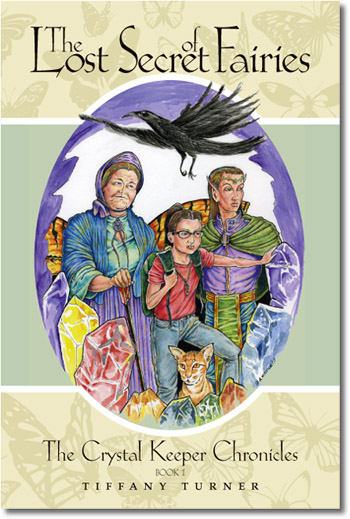
 **The Crystal Keeper Chronicles are available on
  The Indie Children's Authors Connection