Tag Archives: poetry for growing up

Back to School Blog Tour 2025 Day 5 – Jeff Boldt

Standard

Welcome to Day 5 of the 2025 Back to School Blog Tour. On our final day, I’d like to introduce you to a fabulous, children’s poet, Jeff Boldt.  With a background of teaching English in Shanghai for twenty years, he employs his humor and English literature knowledge into his poetry. He grew up in Texas immersing himself in books as a kid. He has been published in the Humor Times, the e-edition of the Orlando Sentinel, and in Doug Weller’s book, Six Word Wonders. I had the opportunity to review his children’s poetry book, It’s Raining Bats and Frogs and ask Jeff all about his inspirations, writing routines, and about his future projects.

Jeff Boldt is the author of the children’s poetry book It’s Raining Bats and Frogs.

What made you want to become an author?

Jeff Boldt: When I was young, I was immersed in books – they were such a big part of my life. Whenever I didn’t want to be in my own world, I would just go to Narnia or Oz or Wonderland instead. But books were more than a form of escape, they also challenged me intellectually and creatively. They had such a profound influence on my sense of self and my place in the world. Because of this, I wanted to be able to share that same experience with others. 

  • Who were your inspirations on your writing journey?

Jeff Boldt: Shel Silverstein, more than anyone, has had an impact on my writing. And not just on my style but on the way I think about writing as well. His work was always so funny and so brilliantly realized. I couldn’t believe that there were entire books filled with ridiculously hilarious and nonsensical things – like “Carrots” and “Everything on It” and “Snowball”. So much of school (and learning) to me was serious and boring and safe – and I thought that was what awaited me in the “real world”. Writers like Silverstein and Dahl and Carroll showed me a completely different way.

  • Do you have a writing routine? If so, please explain.

Jeff Boldt: I have never been good at schedules and structure, but I do make time for writing. I join writing clubs, take online classes (Oxford and UC San Diego), and generally push myself to do things that will challenge me and get me writing more. In other words, I don’t have a writing routine, per se, but I do make it a priority. Along those lines, I am applying to MFA programs right now because I want to pursue writing full-time.

  • For your featured book, how did you get the ideas to write it?

Jeff Boldt: Many of the ideas for my poems come from everyday life (work, spending time with my daughters, going out to eat, etc.). For example, the poem “If” came to mind after walking up some stairs to get to my office. The line goes like this: “If I took a set of stairs / and they led to nowhere / how far would I go / before I would know?” Reading it now, though, it’s hard not to see Pablo Neruda’s influence. Back in university, I used to carry The Book of Questions around with me wherever I went. It’s such a great little book. If you’re interested in philosophy and the absurd, I highly recommend it.

  • What writing projects are you working on right now?

Jeff Boldt: I’ve been tinkering mostly with picture book manuscripts lately (but also writing poems whenever I can). As for the picture books, I have a vowel series and I’ve completed manuscripts for e, o, and u. The u story actually appears as a poem in my latest book. It’s called “The Cnrious Case of the Lowercase u” and it’s a humorous rhyme about two letters, y and a, who can’t seem to find their missing friend.

Book Review

It’s Raining Bats and Frogs by Jeff Boldt is a marvelous children’s poetry book that reminds me of the humorous poetry of Jack Pelutsky. This collection of poems sparks the imagination as it described dressed up dinosaurs, dancing with potatoes in the moonlight, and ridiculous rhymes to recite. It’s a riot of humorous word salad as you read each poem making it a great read-aloud. It had me laughing, remembering when humor was much more simple as a kid.
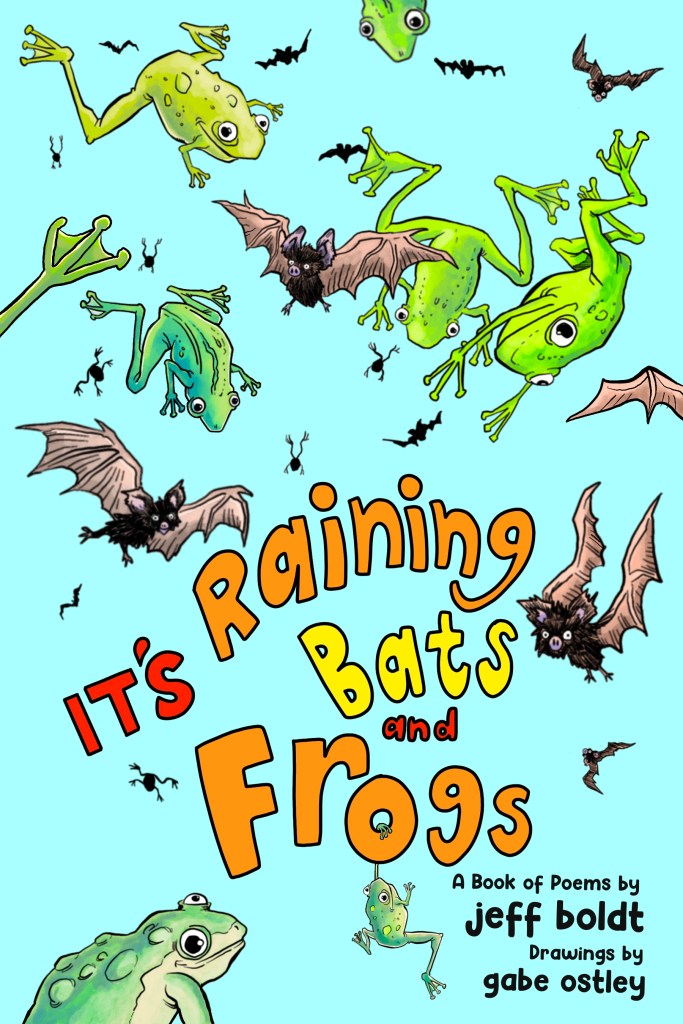
The illustrations are beautiful. Black and white pencil drawings bring the imagery of the poetry to life. Sometimes the cartoon renditions would make me burst out with giggles. The pictures definitely touched my inner child.

I loved Jeff Bodlt’s silly and mischievous mind that thought up these poems. They remind me of the children’s poems by Jack Prelutsky that wrote “Homework, Oh Homework”. I used to read-aloud his book during Poetry Month. I appreciate the use of humor to help kids connect with poetry. These poems do the job nicely. There is a lot of read-loud chanting and word play that will spark the creative side of any child.

I used to do a poetry collage project as a book report each year during poetry month. I would have loved to place this in my class library for my students to read and use for that project. In fact, I’ll place a link below where you can find it now on Teachers Pay Teachers.com.

I haven’t laughed so hard in a long time. These poems are a joy to share and to read out-loud. They will have whole families and classrooms laughing together. Perfect for read-aloud at home or any classroom.

It’s Raining Bats and Frogs is available on Amazon.com and is a Kindle Unlimited title.

For more information on Jeff Boldt, visit his website at: https://jeffboldt.com/.

Thanks for following along with the Back to School Blog tour for 2025. This will conclude the blog tour event for this year. Please show some love to the featured authors and check out their websites, look over their books, and consider your purchasing power when choosing an Indie author. They are so often overlooked for libraries and schools, but really can give new perspective, POVs and protagonists that speak to so many children.

As promised, here is the link to the poetry book report project available on Teachers Pay Teachers. I developed it over the years, making it a poetry collage and memorization project, mostly during Poetry month in March. But it can be done all year long. I wrote and developed it myself.

Thanks for stopping by all week. The Back to School Blog Tour will return next year. For more information on sign-ups, check out the Back to School Blog Tour page.

This is Mrs. turner, signing-off. Until next year, keep reading and writing!

-Mrs. Turner

Interview with Daniel and Madison Davis

Standard

Dan _ Madi

Daniel and Madison Davis are the authors of the children’s poetry book, Melancholy Musings: Children’s Poetry for Life’s Darker Moments

With so much sad news and depressing events happening around us, there is nothing better than poetry to perk up your summer. I’ve found a fabulous father and daughter writing duo. Meet Daniel and Madison Davis. Dr. Daniel Davis is a sociology professor at San Diego State University. His daughter, Madi, loves art, writing and hip-hop dancing. They paired up during the Spring Shutdown to write poetry together to cheer themselves up and to share a positive literature experience with readers.

Their book, Melancholy Musings: Children’s Poetry for Life’s Darker Moments, presents children’s poetry to share and read to help with the stress and pain of growing up and other tragic events in life. I had a chance to ask Madi and Daniel about their writing adventure during this pandemic, and what they have in further store for us.

1) What is your favorite memory from reading as a child?

Madi: I’m still reading as a child! But I did feel happy when I finished the longest Harry Potter book. It was like 600 pages.

Daniel: I remember my mom signed me up for a summer reading challenge at the local library. I read as many kids books as I could, and don’t remember how many it was, but I ended up winning the challenge and felt pretty cool about it.

2) Who was your favorite author and how did they influence you?

Madi: J.K. Rowling is my favorite. I’ve read everything she’s written. They made me really eager to keep reading.

Daniel: For fun, probably Douglas Adams’ The Hitchhiker’s Guide to the Galaxy. I love that genre of zany British humor, always makes me laugh. More seriously, probably Peter Berger’s work on the social construction of reality, which helped me see the many ways that society is our own creation. 

3) Do you have a writing routine? Share what works for you.

Madi: I write whenever I feel like it, but if it’s for school I always finish a rough draft the first day, add to it the second day. If there’s a third day, I spend that one editing it. For Melancholy Musings, there were also some deadlines from my writing coach and Dad that helped keep us going.

Daniel: I try to set up a process for each project. Like for this one, I would brainstorm poem topics with Madi and have her come up with some rhyming word pairs and ideas. Then I might create a few lines another day and she would go over them and add some still another day. It was a back and forth approach. 

4) What subjects would you like to write about in future projects?

Madi: Most things fiction. I sort of hate non-fiction. I like writing stories with drama, suspense, and mystery.

Daniel: Probably non-fiction or journal articles. I’m a sociologist, so either research or materials students can use in sociology classes.

5) How was your current poetry book written?

Daniel: While we were apart, Madi and I shared a Google doc and would take turns talking on the phone and adding lines and poem ideas. Madi also had the idea of making all of the imagery from the same family and centered on the main little girl. As new poem ideas came along, the family of characters kept growing.

6) Why do you feel this was an important poetry collection to create?


Daniel: Children’s books and poems typically center on happy topics or fantasy, but difficult things happen to kids too. We thought it might be meaningful to create a set that parents could pull from to allow for discussions about these things with their kids. Ultimately pets pass away, families have to move or get divorced, loved ones get sick; it can be helpful to have opened up some of these conversations with kids in advance. It helps them understand that these things happen to everyone; they are part of life.

7) What message do you have for aspiring poets?


Madi: Just keep practicing! I could tell by the end, we had better poems than what we had first written.

Daniel: Brainstorm lots of ideas, take your time, have fun with it, and find a good website to help you think of rhyming words.

8) As a parent, why do you think working on a project like this during the pandemic helped you and your daughter cope?

Daniel: It gave us something to focus on other than all of the bad news that was happening every day. We also had little deadlines we self-imposed every Tuesday at noon. So, sticking to some kind of structure like that helped make sure we kept working on it, but also that we made time to FaceTime each other every week. It was nice to connect with her and hear her ideas and thoughts. I could tell some of the topics were easy for her to think of, like the death of a goldfish or getting lost in a crowd, which she had experienced before. But there were other topics that were more of a stretch, like imagining what it would be like to have an older sister go away to college or an aunt tired of hosting family for the holidays.

9) What suggestions do you have for parents trying to help their children through the COVID19 pandemic?

Daniel: It depends on the age of the kids, of course. With a tween, I try to keep her informed and aware of what’s going on, but she doesn’t need daily updates on virus numbers and such. She is careful about social distancing and understands it, but not getting to see her friends or have her fifth-grade promotion, missing summer trips and camp are certainly a disappointment. The pandemic will forever be a milestone of her generation’s collective memory, like 9-11 for the cohort before. But unlike 9-11, Covid-19 is such a prolonged tragedy. It’s hard to say what the long-term impacts will be.

But I think the best thing we can do is keep listening to our kids and giving them room to process. It’s an unprecedented situation, so it’s hard to give one-size-fits-all advice. Different kids will need different things. But, I think if we listen empathetically and ask lots of questions about how they feel, in most cases they can tell us what they need. We don’t have to guess.

10) What is writing to you in one sentence?

Madi: Writing is a hobby that I really like, especially writing surprising stories where a character might get hurt, go insane, or die all of a sudden. Not really horror, but things people don’t expect me to write.

Daniel: It’s a way to share ideas and inspiration with others, and possibly even a way to create a legacy that will outlive us.

Melancholy Musings Front CoverMelancholy Musings: Children’s Poetry for Life’s Darker Moments is a fantastic read-aloud to share with family to discuss times such as the pandemic or the other difficulties children face. Death of pets, life transitions, moving to a new place and others can be difficult events in a child’s life. This collection addresses these tough subjects along with others in a humorous and empathic poetic approach. It encourages families to have discussions together with poetry as the catalyst. Written as collaboration between a father and daughter during the Spring Pandemic Lockdown of 2020, these light-hearted poems will be a wonderful addition to any home library.

Book Trailer Link: https://www.youtube.com/watch?v=ro1xd9P1qKU&t

Melancholy Musings: Children’s Poetry for Life’s Darker Moments is available at: Amazon.com. This is a Kindle Unlimited title.