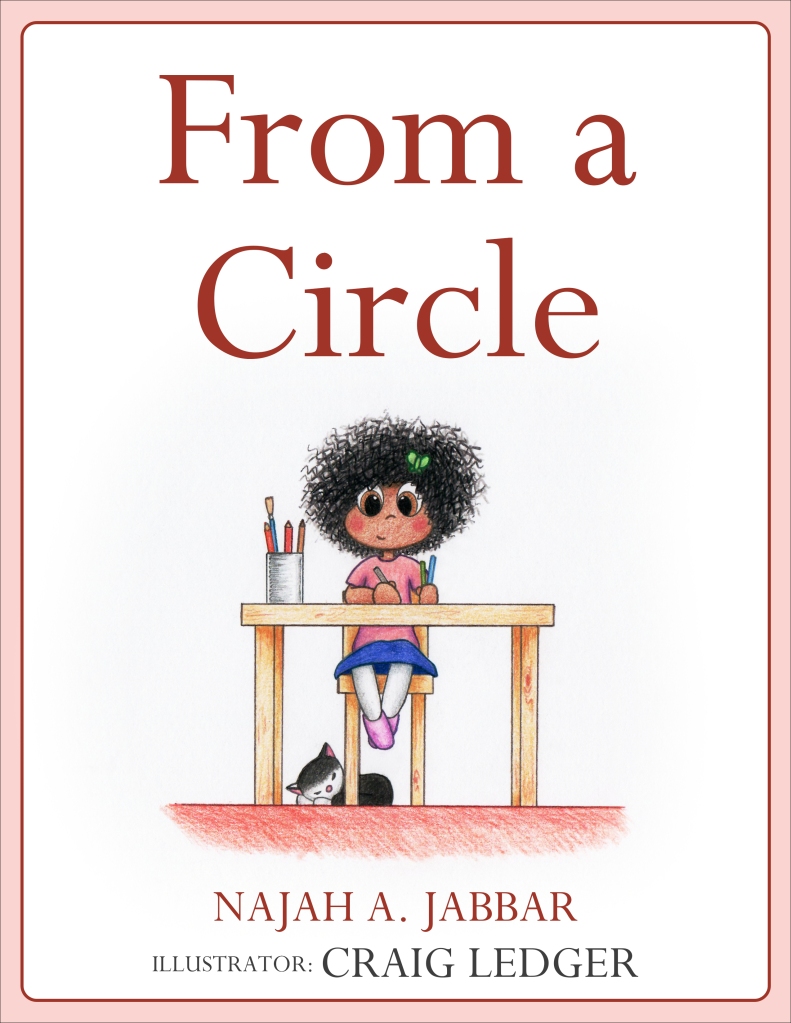
From a teaching perspective, this is the time of year where we start getting deep into the curriculum. I’ve found a book series and fabulous author that uses her teaching experience to create a unique, math and literary oriented book experience. Najah A. Jabbar is an elementary school teacher that has had a career also as a journalist. She combines these two areas of expertise to create a unique reading experience. Her new book, “From a Circle” is a continuation of her “From a Shape” series. It is a great way to introduce math concepts to your students or to your child in this current distance learning and home schooling environment.
I had the chance to talk to Najah about her reading memories as a child, inspirations as a writer, how to use her new series to introduce math concepts, and what she has in store for future projects.
1) What is your favorite memory from reading as a child?
Najah A. Jabbar: I was fascinated with fairytales and folktales, whether told by my mother, grandmother or read in published books. I would spend my library time sitting on my knees in that aisle, soaking in all the magic and lessons. Mostly, I was intrigued by the problems and solutions. While I don’t write in those genres, they made me aware that books speak to our inner selves, almost like telepathy. What’s going on in a child’s head is the inspiration for the “From a Shape” series, which “From a Circle” and “From a Rectangle” are a part of. The series introduces mathematics and artistic design to young readers while challenging them to figure out the problem.
2) Who was your favorite author and how did they influence you?
Najah A. Jabbar: My favorite writer is Fyodor Dostoyevsky for the novel, “Crime and Punishment” because of the way his writing absorbed readers into his character’s subconscious.
3) Do you have a writing routine? Share what works for you.
Najah A. Jabbar: The only routine I have is that I don’t have a routine. I feel bogged down if I must write. But that isn’t to say that I am inconsistent in writing. I am able to write in my head and play with it there. Sometimes I am crushed since I don’t have the luxury to write for a living, but then I visit that part of my brain to check if the stories are there and it’s a real good feeling when I find they can still come together.
4) What subjects would you like to write about in future projects?
Najah A. Jabbar: I want to continue with the “From a Shape” series, which incorporates elements of math, literature, and art. Right now, I am close to finishing the Lizzy and Izzy From a Shape series. While the story problems are universal, the illustrations in the first “From a Shape series represents the African race. (The first edition of From a Circle was published in 2015). But my plan is to represent all ethnicities in the illustrations with each new shape series.
5) Where did you get the idea to write your book, “From a Circle”?
Najah A. Jabbar: It’s a funny story about how “From a Circle” came to be. Before its conception, I wrote short stories, not children’s stories. My first attempt at writing a children’s book was in 2012, two years after my daughter was born. It read more like a poem. Really, it had no problem. But in 2014, my daughter drew a stick figure with a missing part. Bam, that was the problem I needed to make my story happen.
6) What kind of advice would you give aspiring writers?
Najah A. Jabbar: My advice to aspiring writers is to be your own kind of writer. To do that, you need to learn to listen to your inner self, because while you may have grown on the outside, that inner self is any age you want her to be. One other piece of advice, which helps me as a writer, is to draw your scenes, to test your story. So, when I’m done writing, I go scene by scene and sketch it out, basically scribbles in boxes, yet it helps you review the stories cohesiveness.
7) How is writing a picture book different than reporting for a newspaper?
Najah A. Jabbar: At one point in my life, I wrote for MetroNorth Newspapers, even winning a couple of Colorado Press Association awards. I became a journalist, so I could get paid to do what I love to do. There’s a fine line between fiction and reporting. Obviously, stories for newspapers must be fact-based. Fiction can be imagined, yet it needs to be believable or made possible in your reader’s minds, or you won’t hold them in your story. Be forewarned, while journalism helped improve my writing, it quieted my imagination to the point that I had stopped writing.
8) What has inspired you as a writer?
Najah A. Jabbar: When I first conceived “From a Circle,” it hadn’t occurred to me that I had a potential series. It took two years before the second book appeared. At that time, I worked as a guest teacher at Denver Public Schools. One day I happened to be in a preschool classroom. This little girl drew a house with a missing part. Bam! The next book played in my head for a week before I wrote it down. Thereafter, problems didn’t need to occur in reality for me to recognize a potential story.
9) How would you suggest a teacher could use the book, “From a Circle”?
Najah A. Jabbar: “From a Circle” incorporates art, math, and literature. Teachers could use the story as a starting point to teach children about shapes and elements of fiction. The problem in the story will keep students guessing until the end. Most importantly, this story could lead to conversations about helping friends.
10) What is writing to you in one sentence?
Najah A. Jabbar: Writing has nothing to do with your outer self, most of the time you’re unaware of the world around you, or the writing itself; you’re basically out of this world.
“From a Circle” is the next installment in the “From a Shape” book series. This time, Lizzy and her pencil dream of creating a perfect, circle friend. But instead, a smiling face appears from a lopsided circle. She tries again and again, sending her on the journey into her imagination. This is a great book to teach art and math, along with the exploration of a child’s creativity. Perfect for distance learning, home schooling, or for class read-alouds. Recommended for ages 3-8.
“From a Circle” is available at Amazon.com and is a Kindle Unlimited title.
For more information on Najah A. Jabbar, please visit her website at https://crazypigeonpress.com/ and her Amazon Author page at: https://www.amazon.com/Najah-Jabbar/e/B08BZSTSR9.


 The Indie Children's Authors Connection