Category Archives: Picture Book Recommendations

A Second Interview with Michael Dibley

Standard

The holidays will soon be upon us. Likely, thoughts of what gifts to get are churning in your mind for your child or grandchild. Books are great gifts! Picture books are wonderful ways to connect with your child during read-aloud time before bed and to stimulate their imagination. So, I’ve been gathering info on some great new picture books for you to consider for your child’s home library. Teachers, these would be great for your class library.

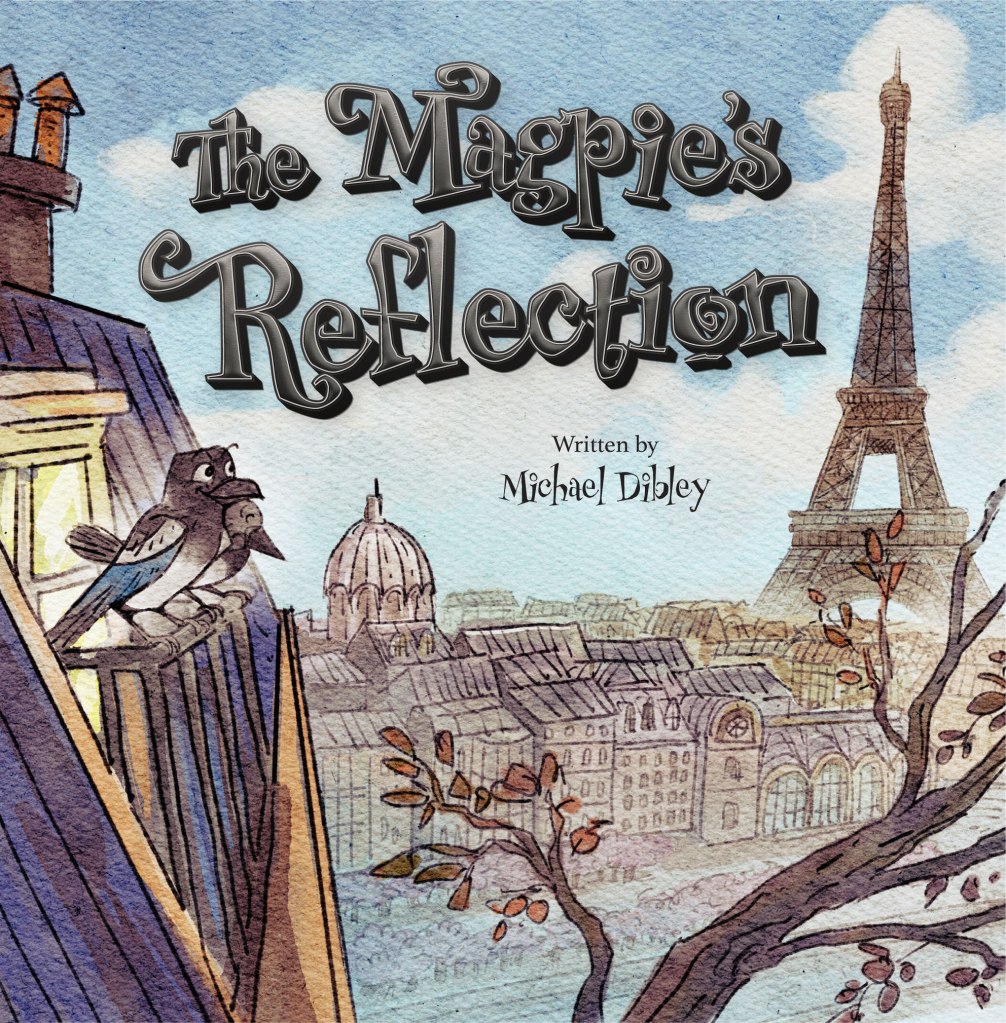
 “The Magpie’s Reflection” is my first choice for your gift giving list. It’s a great story about losing something you take for granted and then trying to recover. Your child will meet Magnus, a magpie thrown into a moment of turmoil and shown kindness to survive. This touching story will warm your heart as it did mine. I had a chance to interview the author, Mike Dibley, about his love for writing and reading, and what he’ll be up to in future projects.

  1. What is your favorite memory from reading as a child?

Mike Dibley: Probably reading Peter Rabbit books. There was something magical about them. I also fell in love with the watercolour style of the books, something that has kept with me after all this time.

2) What subjects would you like to write about in future projects?

Mike Dibley: Children’s books are what I want to keep writing about. It’s all an adventure, whether it’s stories told or stories to learn. It’s all fine with me.

3) What is writing to you in one sentence?

Mikie Dibley: Writing is relaxing and a way to declutter thoughts.

Book Blurb/Cover:

High above the bustling city, two magpies Millie and Magnus perch on a rooftop, judging the world below with sharp eyes and sharper beaks. But when a powerful wind sweeps them apart, Magnus is thrust into a journey he never expected. Lost and alone, Magnus is rescued by a kind old woman who shows him a different side of life, one filled with warmth, kindness, and self-discovery.

As he heals, Magnus begins to see himself and others through a gentler lens. But will he ever find Millie again? And if not, can he find the courage to fly forward into the unknown?

“Magpie’s Reflection” is available on Amazon in Kindle or paperback format.

Link here for the first interview with Mike Dibley and information on his book, “Iwa, the Snowflake”.

For more information on Mike Dibley, please visit his Amazon Author Page.

Back to School Blog Tour 2025 Day 3 – Book Review of “Brave Enough: Atlan and the Farm Animals”

Standard

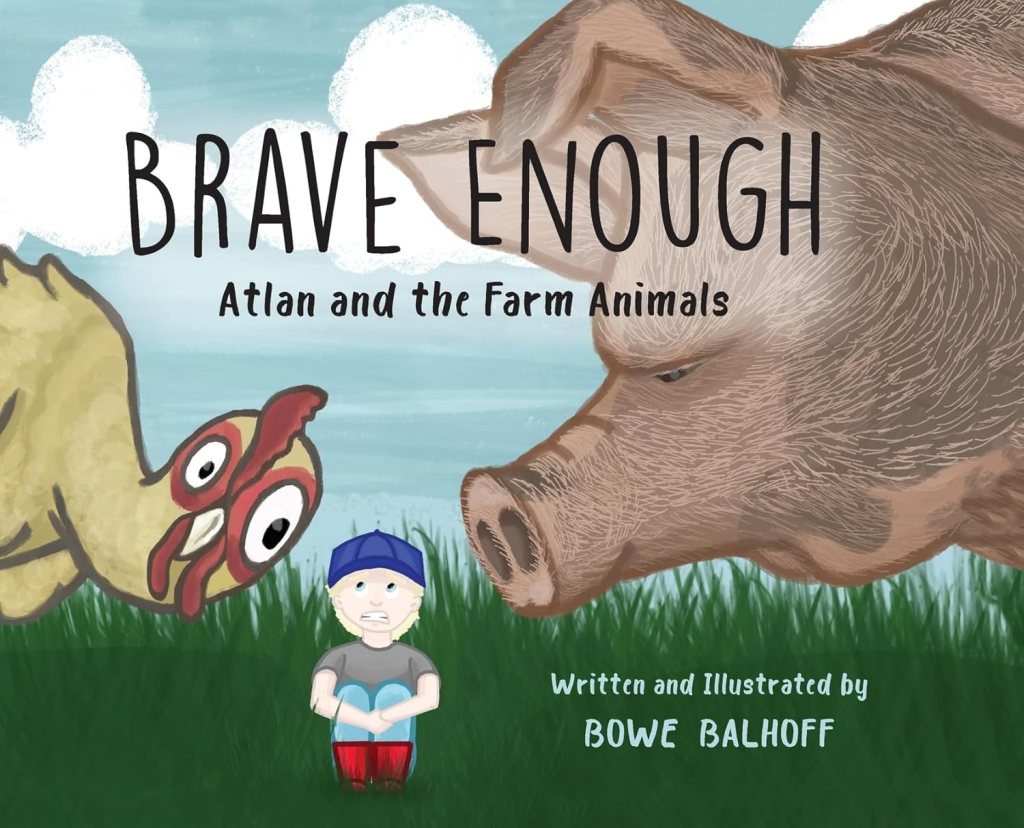
“Brave Enough: Atlan and the Farm Animals” by Bowe Balhoff is a charming picture book of facing fears and unknown experiences on a farm. The main character, Atlan, is a quiet 4-year-old boy based on the author’s real son. He is experiencing his first trip away from his parents by spending time on his grandparents’ farm. The kindness and love that surround the little boy start the story. The grandparents start with comforting things to calm his fears of his new surroundings. Home-made ice cream is the ticket. But of course, new experiences, such as feeding chickens and a pig, could be overwhelming for any 4-year-old. They kindly guide him through these activities.

The unique aspect of this story is that Atlan changes into an animal several times when scared, expressing how he feels in relation to meeting the other animals. First, he turns into a snail while feeding the chickens. Then, he turns into a mouse when meeting the pig, and so on. The animals he turns into embody his feelings. These are such relatable symbols for children dealing with new experiences and the real fear that goes along. When he has acknowledged his feelings for the situation, he changes back into a boy. It’s such a nice way to show this emotional change for the character. His grandmother’s voice is the catalyst for the emotional growth as she guides him into navigating his fear of the farm animals.

New experiences such as feeding chickens and a pig could be overwhelming for any 4-year-old. I loved the way that this story acknowledges those fears, and brings comfort to the character and the reader alike. Techniques to help with anxiety are shared within the story, such as slow breathing, trying to look at a new point of view, and trying to focus on the fun aspects. Granny’s protective arm, showing the support of family, is another life line for the character and reader.

Overall, this is a great story showing a young boy facing the unknown with support from his family. I would recommend this book to any parent or teacher that is trying to model how a child can face unknown challenges, navigate their complex feelings, and look to their family for support. This would be great for any class or home library. Grandparents would find this a fabulous gift to give their grandchildren, especially if they own a farm.

“Brave Enough: Atlan and the Farm Animals” is available at Amazon.com and Barnesandnoble.com.

For more information on books by Bowe Balhoff, visit her website at: https://www.bowebalhoff.com/.

Interview with Shanna Ward

Standard
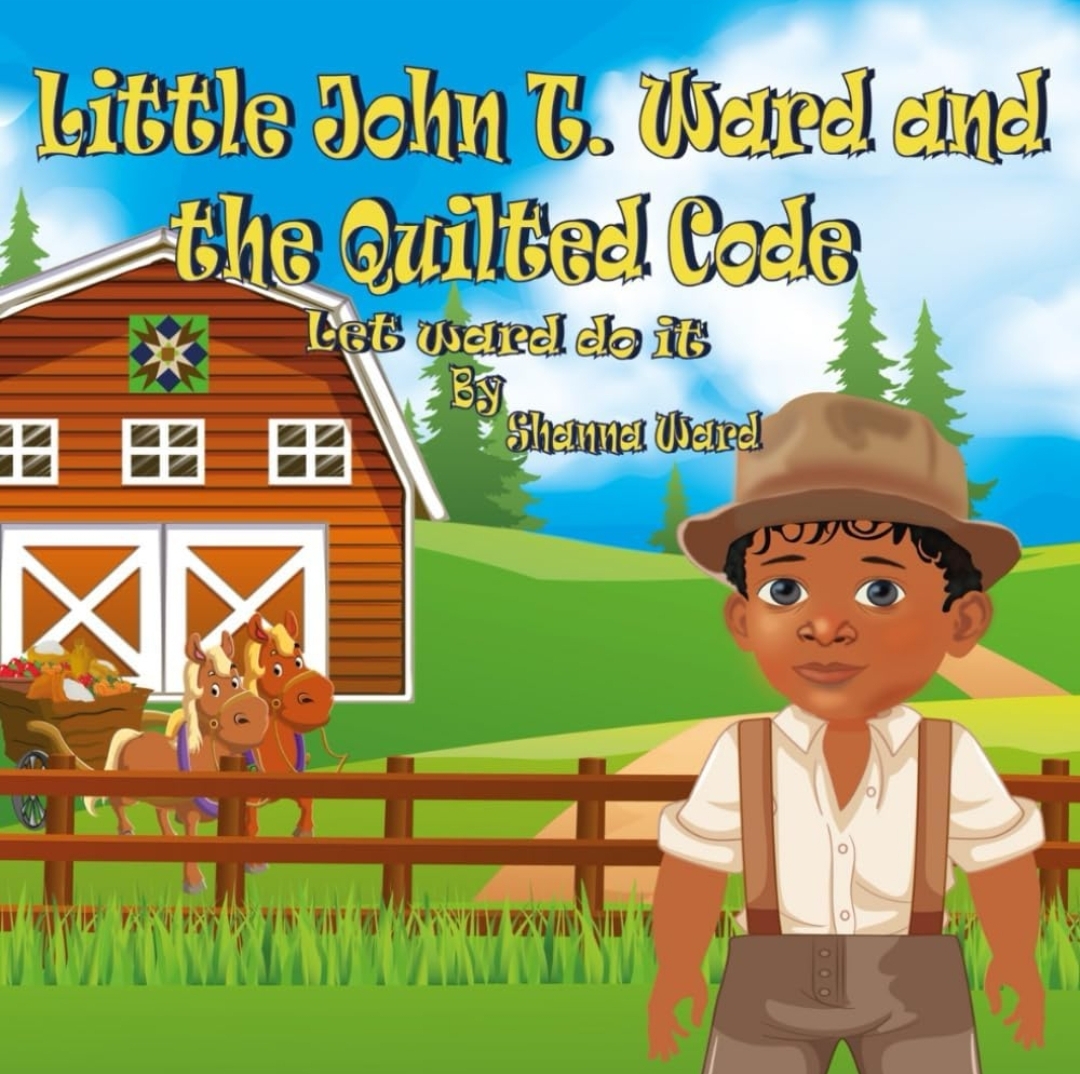
Shanna Ward is the author of the picture book “Little John T. Ward and the Quilted Code: Let Ward Do It“.

Summer is upon us, and it’s time to think about keeping your child’s mind engaged in learning by reading. This is a crucial time to continue to stress reading so as to not lose the gains that happened during the last school year. This is easy to do with selected educational bedtime stories or on your child’s at home D.E.A.R. (Drop Everything And Read) time.

I have a great summer reading and Juneteenth recommendation along with an interview with the author. “Little John T. Ward and the Quilted Code: Let Ward Do It” is a way to bring historical references to teaching about unity, friendship and the courage to speak out and make a difference. Using her connection to her ancestor, Shanna Ward has brought to life the story of a boy that helped fight oppression. She brings the insightfulness of a boy helping others with beautiful illustrations expressing the struggle and story. I had a chance to ask her some questions about what inspired her as a child, what her writing routine is like, and what she has planned along her writing path.

1) What is your favorite memory from reading as a child?

Shanna Ward: One of my favorite memories from reading as a child was sitting with my Grandparent’s parents before bedtime as they read my favorite story to me. It was such a comforting and bonding experience, and I always looked forward to spending summers with them. The characters and adventures from the story would come to life in my imagination, and it was a magical time that instilled in me a lifelong love for reading.

2) Who was your favorite author and how did they influence you?

Shanna Ward: I have always been drawn to Judy Blume’s relatable and honest depictions of the joys and struggles of growing up. Her characters faced real-life challenges and emotions, making her books deeply resonant for me as a young reader. Blume fearlessly tackled topics like friendship, family, and the complexities of adolescence with authenticity and empathy. Her writing normalized the experiences and feelings I was navigating, making me feel seen and understood. Judy Blume’s ability to address sensitive subjects with compassion and understanding has had a lasting influence on my own approach to empathy and storytelling.

3) Do you have a writing routine? Share what works for you.

 Shanna Ward: I make it a habit to write every day, usually late at night when my mind is more creative. I start by outlining my main points and organizing my thoughts. Then, I dedicate uninterrupted time to writing and setting specific goals for the day. I find that this routine helps me maintain focus and productivity. Additionally, taking short breaks between writing sessions helps me stay energized and maintain a clear perspective on my work.

4) What subjects would you like to write about in future projects?

 Shanna Ward: I would like to explore writing about topics such as African American History, Insurance, and travel experiences. These subjects align with my interests and allow for creativity and exploration in my writing. Additionally, I am open to branching out into new areas that can expand my knowledge and offer fresh perspectives to my audience. I’m currently writing a psychological thriller and tap into narcissistic characteristics.

5) What is writing to you in one sentence?

Shanna Ward: To me, writing is a creative expression that allows me to articulate thoughts, share stories, and connect with others on a deeper level.

Book Blurb:

Join Little John T. Ward on a journey of kindness and courage as he, alongside his ponies Libby and Dom, discovers the power of unity and friendship. As he aids escaped slaves in finding their way to freedom, John T. and his community learn that even a small boy can make a big difference. With vibrant illustrations and heartwarming moments, this tale is perfect for young readers aged 6-9, teaching them the importance of helping others and working together. This book is an essential element to teaching about the injustices of slavery to the younger generation.

“Little John T. Ward and the Quilted Code: Let Ward Do It” is available on Amazon.com and is a Kindle Unlimited title.

For more information on Shanna Ward and her book, visit her website at: https://www.bequest1820project.com/.

Meet Shanna Ward in person at the Columbus Book Festival in the Indie Authors Alley.

Interview with Pompey Poppleton

Standard

Are you looking for the perfect Christmas gift or stocking stuffer? Does your child or grandchild like books with a sense of humor? Do they like books with dogs? If so, I’ve found a great combination that will make the perfect Holiday gift for your young reader.

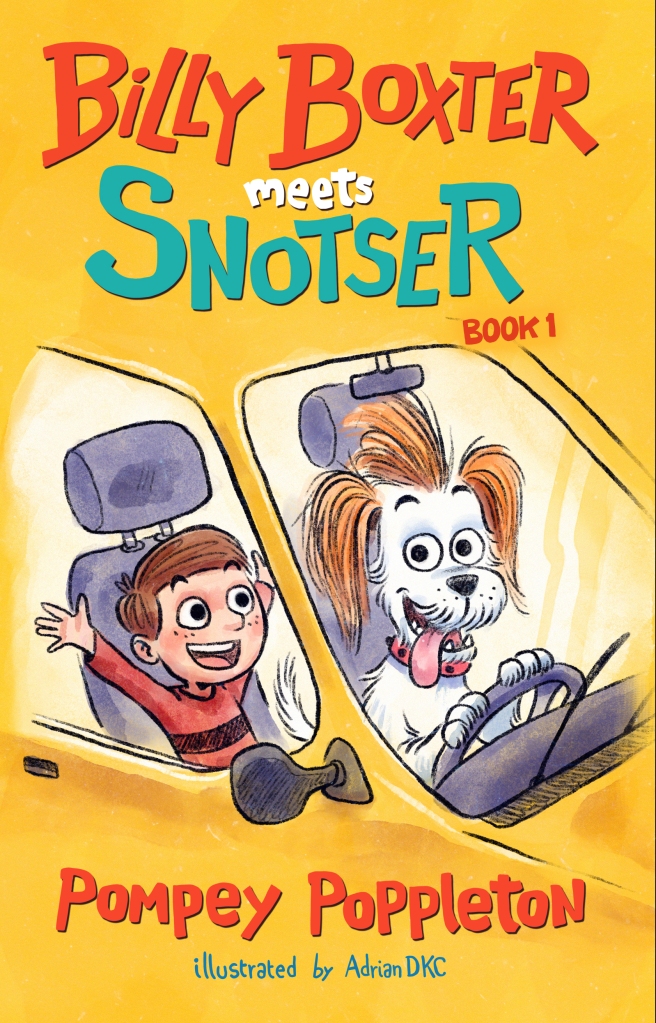
“Billy Boxter Meets Snotser” is a farcical book that tells the story of a troublesome foster dog. Billy thinks he can tame the dog, and the story that unfolds will warm your heart.

Pompey Poppleton is the author of this book. He lives in a small village on the west coast of Ireland, and he draws from his childhood and literary background to write his stories. I had the opportunity to talk with him about his writing journey and how he wrote his debut book.

What is your favourite memory from reading as a child?

Pompey Poppleton: I read only Sinead de Valera books as a very young child for many years. Sinead’s stories were all based on Irish myths, fairies, ghosts and witches. During the summer months, my granddad and I, with his beloved cocker spaniel Suzie, would walk every evening. We’d walk together past an old cottage by a towering gnarly, oak tree and hop over a large metal gate through poppy fields that led into a dark forest. We would be gone for hours.

It was thrilling to visit ancient sites like a hill fort as well as my cherished mystical forest. Enchanted lakes, forests and witch’s cottages were often the locations for many of Sinead’s books, which brought her stories to life when I would later be in bed reading them after my walks. I would have a perfect image in my mind based on where we had explored and the stories became so much more invigorating and realistic to me. Her books instilled in me a love for reading, history, the Irish landscape and the other world, the world of mythology.

Who was your favourite author and how did they influence you?

Pompey Poppleton: From the age of eleven, I started reading P.G. Wodehouse books, and he was a major influence in how I wrote the Billy book. I love the fun and farcical element to his stories with silly names thrown in. My favourite is The Blanding book series. The dotty Lord Emsworth, who faithfully adores his pet pig, is my favourite character out of all the P.G. Wodehouse books. Mr. Kringle is loosely based on him. He also adores and spoils his pet cat, an old Ragamuffin, called Orangutang.

Do you have a writing routine?

Pompey Poppleton: Not in terms of time, I wouldn’t ever decide to sit daily for a certain number of hours to write. But as regards to story writing and plotting, I would always follow a particular routine and that is to write everything by hand.

I like the freestyle method. I just write whatever comes to mind, and then later organize into characters, names, traits, themes, chapters and so on. I could get an idea for a name, Billy’s dog for example, but then how I want Billy to look could just pop into my head so I would write that down too. Everything looks a mess in my A4 notebook with random lists and words like names, locations, plots and anything that comes to mind just written down. It really is chaos to anyone else looking at my notes. My ideas would come to me, always when I am out and about, like a quirky name or location. So, I would make a note of it in my phone or into a notepad.

The next stage would be to decide how many chapters I would like. Again, I would write under each chapter title, add rough ideas, and organize what event or story would happen. That would give me direction as to where the book was coming from and going to. If that felt right, I would proceed with more details and particulars in relation to plot and character.

This book has been fifteen years in the making. It wasn’t easy in the beginning to write so freely and to be farcical. When I decided to let go of what I thought the book should be, I then began to write the way I really wanted. That was when the story truly came alive and the ideas flowed readily. The book was finished in no time.

Book Blurb for “Billy Boxter Meets Snotser”:

Snotser is a 2-year old parson terrier. Injured and starving, he was brought to the shelter after being abandoned. He’s fostered many times, but none of the fosterers have any patience with him. Billy finally adopts Snotser, but chaos ensues just as Mrs. Dank, the rescue warden, arrives for a final unannounced visit.

Snotser must now go to obedience school and pass his course. This is Snotser’s last chance to stay with The Boxters. Will Snotser be denied his forever home? Can Billy devise a plan that will work? Or will Snotser get drawn into more trouble that could sabotage Billy’s plan to keep him.

“Billy Boxter Meets Snotser” is available at: Amazon.com and Barnes and Noble.com.

For more information on Pompey Poppleton, please visit his Amazon author page here.

Website link will be available soon.
Second Interview with Simone Chasey

Standard

Greetings and happy holidays! With December looming with its oodles of activities and holiday cheer, it’s good to take the time to connect and read with your child. One of the authors I’ve featured before has a second book in her short story series. Her series is a great way to connect and build morals during bedtime and read-aloud time.

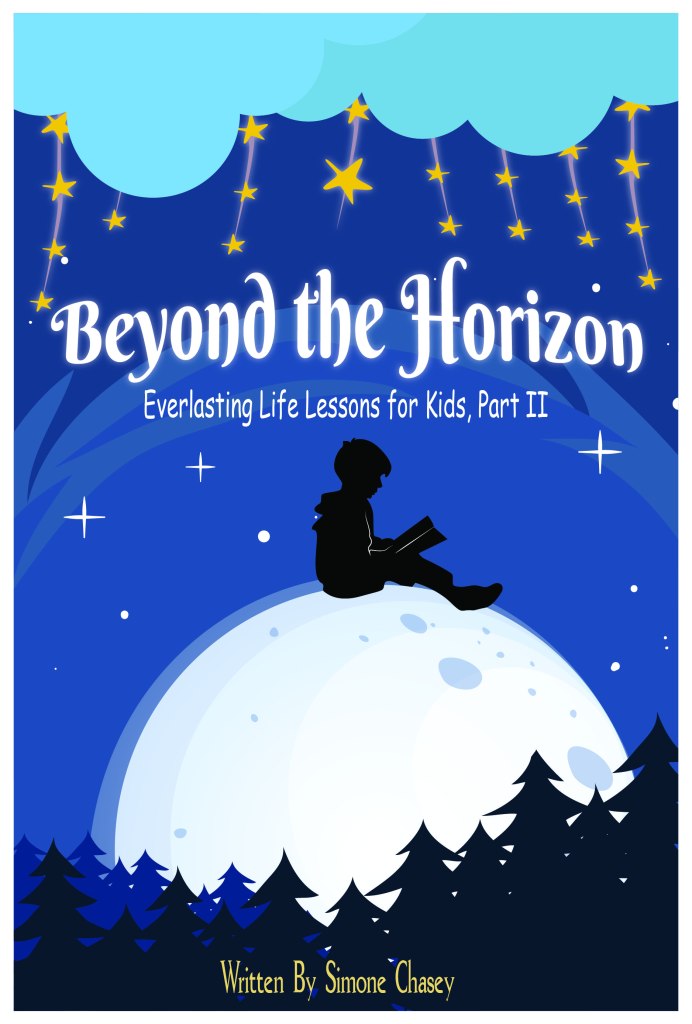
Simone Chasey loves to build a bridge with her literary works that bring parents and children closer together. With her second book, “Beyond the Horizon: Everlasting Life Lessons for Kids Part II”, she is continuing her mission to use reading to build and enrich family bonds. I had the chance to catch up with Simone with her writing journey over the last year and find out what she has planned for further parent-children relationship enrichment.

1) What is writing to you in one sentence?

Simone Chasey: Writing is the creative art of weaving thoughts, emotions, and ideas into a tapestry of words that helps the reader use their imagination, learns to communicate, and resonates with others.

2) Do you have a writing routine? Share what works for you.

 Simone Chasey: At first, it was merely an idea that sparked in my mind — a desire to impart moral lessons to children. As new ideas continued to emerge, I began jotting them down on a notepad, laying the foundation for future books I have yet to create. This approach ensures a constant stream of projects to work on.

3) What subjects would you like to write about in future projects?

 Simone Chasey: In considering future projects, my focus transcends subjects; rather, I envision crafting experiences that transform learning into a captivating and interactive journey. My ultimate goal is to infuse the joy of discovery into education, making the process not only enlightening but also entertaining.

Moreover, I aspire to contribute to the strengthening of family bonds, creating literature that not only facilitates learning but also serves as a conduit for parents to engage with their children. Through stories that resonate with both young and old, I aim to mend the bonds of family, fostering shared moments of reading that become cherished memories, and nurturing connections that endure beyond the pages of a book.

Book Blurb:

“Beyond the Horizon: Everlasting Life Lessons for Kids Part II” is a compilation of short stories that transports young readers to a world where imagination converges with wisdom. This collection explores essential life lessons through captivating tales, ranging from the thrill of success to the valuable teachings hidden within failures. Each story introduces endearing characters on unique journeys of self-discovery, engaging children’s imaginations while imparting morals that linger throughout their lives. From resilience to compassion, courage to the true meaning of success, this book weaves storytelling magic with life’s richness, providing a blend of entertainment and enlightenment. These tales gently guide children to explore emotions, confront fears, and make wise choices, making it a valuable tool for parents, teachers, and caregivers. This timeless collection not only entertains but also educates, leaving an indelible mark on the hearts and minds of young readers.

To find out more about her first book, please click here. This is a Kindle Unlimited series.

For more information on Simone Chasey and her other books, please visit her Amazon authors page here. Also available is her Instagram account here.

To read her first interview on my blog, please visit here.

Interview with Brandon Green

Standard

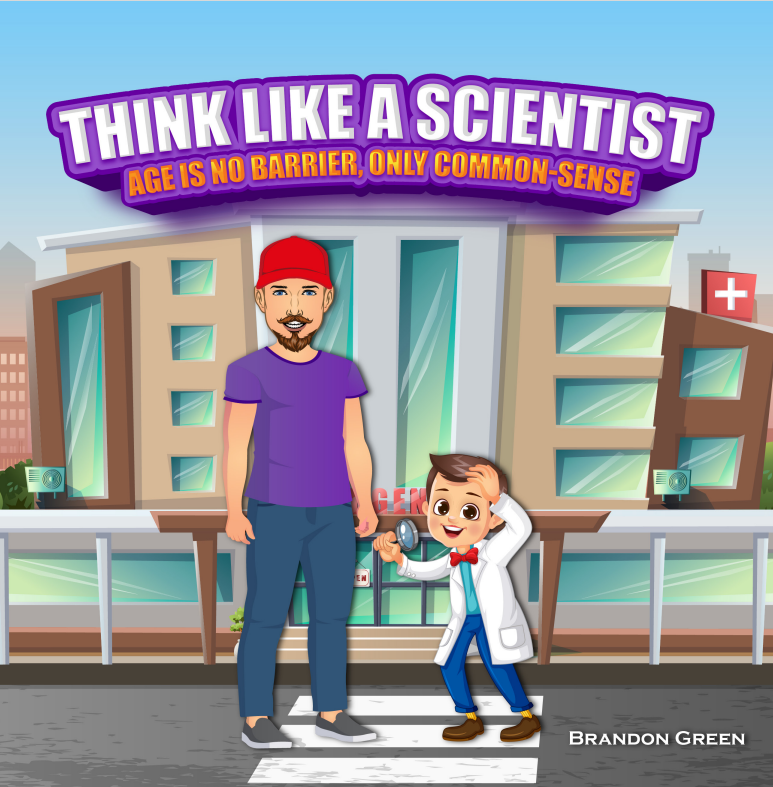
Planning science units can be hard, especially when trying to find the right read-aloud to go with your unit. Plus, home schooling parents might enjoy this book for making scientific connections in literature. I’m talking about the book “Think Like A Scientist”. It’s a story that features being brave, always asking questions and to never give up.

I had a chance to ask Brandon Green, the author of “Think Like A Scientist”, about his inspirations and writing routines. Brandon Green is an Australian author that uses his background as a businessman and entrepreneur to guide his writing. He runs a podcast sharing his experiences as a “Digital Nomad”, and has also written a book on self-help called “Become a Loser to Become a Winner”. I hope you enjoy this behind-the-scenes look into Brandon Green.

What is your favorite memory from reading as a child?

Brandon Green: My favourite memory reading as a child was having my favourite book read to me by different people, as everyone tells the same story differently.

Do you have a writing routine? Share what works for you.

Brandon Green: I just set myself a goal to do it, and try to knock it all out in one sitting. It’s very hard and distracting for me to work at a target over a longer period of time

What is writing to you in one sentence?

Brandon Green: To me, writing is all about the ability to put a story together. From constructing something well-detailed just from a small idea, and having it flourish.

Blurb for “Think Like A Scientist”

“Jack’s dad gets sick with strange symptoms that doctors can’t figure out. Feeling lost and worried, Jack decides to think like a scientist. He asks questions and looks for his own answers. This story shows how Jack uses his smarts to help his dad when the experts can’t. It’s a tale about being brave, asking questions, and never giving up.”

“Think Like A Scientist” is available at his website letsgobrandongreen.com for free as a free downloadable ebook.

Book Recommendation: Charming ABC Picture Book Series

Standard

Sometimes I come across a helpful selection of books that I can see would add to any classroom’s curriculum. Then there are times I find a series of books that would be helpful for specific needs in the classroom. I like to point these out to help out teachers and parents that home-school. It can be hard going through all the different websites and library catalogs trying to find what you need. Let me help you from time to time. When I come across books I know that are going to help, I always present them to you as a book recommendation.

For this book recommendation, I’ve found a set of ABC picture books with a unique connection to the curriculum that will help you tie your teaching with alphabet letter recognition, science and health science, physical education, and imagination.

They are a set of ABC books written by Catherine Anderson-Barnes. She has written two books that introduce the alphabet by means of animals and by fruits and vegetables. Each book can be used for a daily letter introduction, or even, at certain times during the week, in a lesson or as a read-aloud introduction to the letter.

Catherine Anderson-Barnes says about her books:

“The books are filled with a great variety of learning opportunities: Learning colors, letters (upper and lower case), parts of our body, how foods play a role in our overall health, the importance of being physically active, fruit and vegetable recognition, animal recognition, and how animals are similar and different from us.”

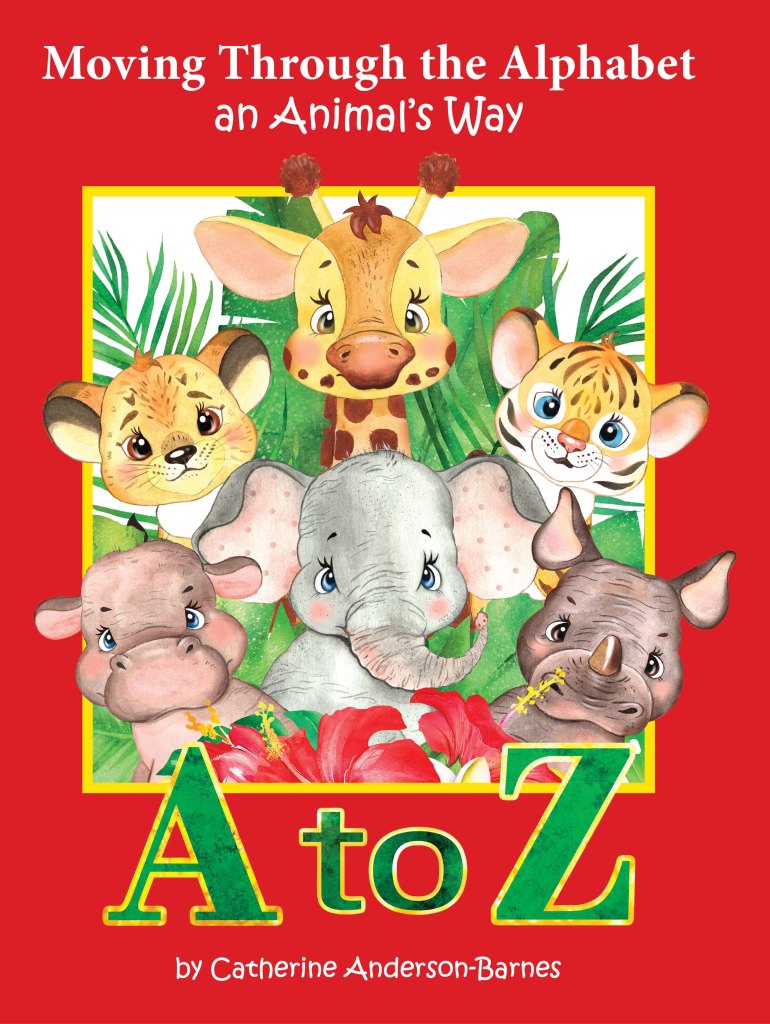
“Moving Through the Alphabet an Animal’s Way A to Z” introduces an animal from around the world with each letter. The colorful and fantastic illustrations dazzle the eye as facts about the animal are listed on the page to read-aloud. At the end of the facts, a fun physical activity can be done that mimics the animal’s natural movement. It’s wonderful to help associate the letter with the movement and build connection with literature.

“Be Your Best…Eating Fruits and Vegetables A to Z” introduces each letter with a tasty fruit or vegetable. Diagrams point out which areas of the body the food supports with a rhyming connection to the letter. Colorful illustrations showing kids in positive activities support the need for a healthy, eating lifestyle.

I love the fact that these books can be combined to help build letter recognition, theme for a food and animal of the week, and even help review later in the year. These can be a staple for any preschool or kindergarten classroom, and a great way to review the alphabet at the beginning of first grade. I highly recommend these books for the classroom and home library. They are a fun and interactive way to learn letters for any child.

Both books are available on Amazon.com as hardback, paperback or Kindle editions.

The books are also read by the author on YouTube as well. Here are the links below! These are great for modeling text and reading aloud skills.

Link for “Moving Through the Alphabet an Animal’s Way”.

Link for “Be Your Best…Eating Fruits and Vegetables”.

Interview with Michael Dibley

Standard

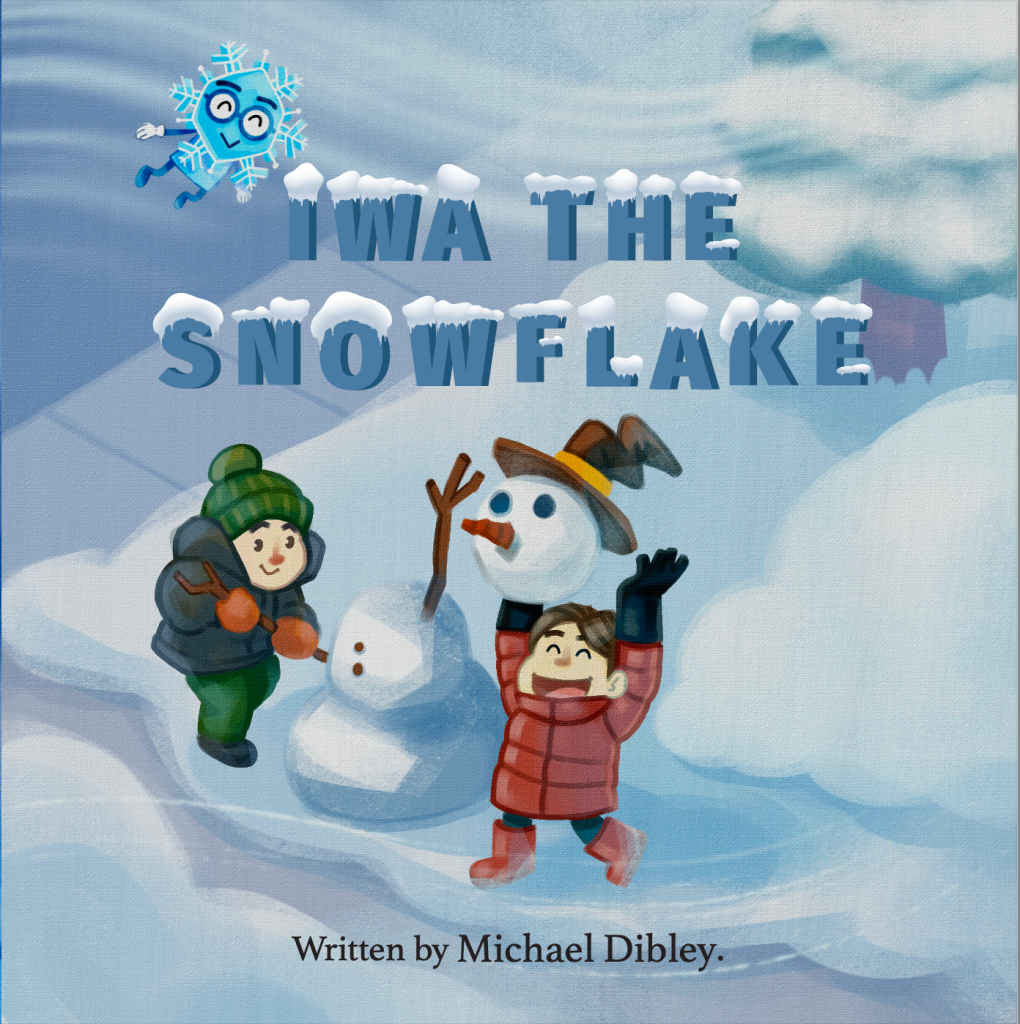
For many of you, school has started and Halloween is just around the corner. But it’s never too soon to start planning for the Holidays. I’ve found a great picture book author with a talent for whimsical illustrations. He captures the essence of each animal in his Whispers in the Woodland series. His new book, although not part of the same series, follows in the same footsteps. His hand-drawn style lends a comforting touch to his characters. I had the chance to ask him about how he became an author, his influences, and what he has in store in the future.

1) How did you come to write the book?

Michael Dibley: I have a friend called Iwa that I used to live with. Somehow, I can’t quite remember, but she started singing this children’s Christmas song entitled “Snowflake”. So I had her name, then snowflake, and the two clicked together for me. Well, there you go. She actually helped a lot with the ideas. We did discuss the book and the plot before pen was put to paper.


2) Who are your main influences when writing?

Michael Dibley: I love Beatrix Potter, Amy MacDonald and Nick Butterworth. Any book that has a good story and beautiful illustrations always helps. These are all authors from my childhood that I still cling onto.


3) I can see you’ve published quite a few children’s books, do you have anymore lined up?

Michael Dibley: I do. I have one that will be released later this year entitled “Sophie the Hedgehog”. It’s part of my Whispers in the Woodland series. I’ll put information on my author page below when it is available.

Book Blurb for “Iwa the Snowflake”:

A scary situation for any child is to be separated from their family. It’s no different for Iwa the Snowflake. She finds herself lost during a storm and desperately wants to get home. It’s the start of a new adventure as she discovers a new world. But can she get back in time before the sun comes back out?

“Iwa the Snowflake” is available at Amazon.com and Barnes and Noble.com.


For more information on Michael Dibley, please visit his Amazon Author’s Page.

Interview with Luci Hollenkamp

Standard

A very happy spring to you and your kin! Hopefully, it is starting to warm up and flowers are starting to bloom where you are. Our thoughts turn to hopeful tidings, and it is wonderful to reflect that with the literature we share with our children and students.

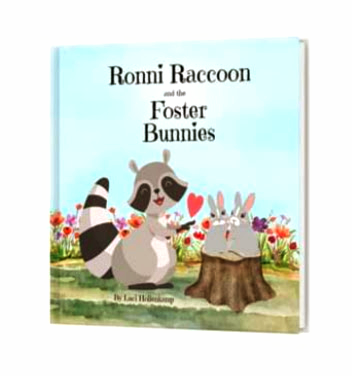
I have found a wonderful book that gives insight to a supportive structure to children in foster care. “Ronni Raccoon and the Foster Bunnies” is a picture book written by a former foster parent.  Luci Hollenkamp captures the nurturing and supportive environment created to support children in any type of family. She used experiences as a foster parent and as a capable auntie to help write the book. Luci Hollenkamp shares some of her story inspirations from participating in foster care and from her nieces and nephews in her interview below. Enjoy!

  • What is your favorite memory reading as a child?

Luci Hollenkamp: When I was young I was a bit of an insomniac. I used to hide under my covers with a flashlight and read late into the night. In the winter, when it was cold out, you could hear the wind howling and the windows rattling. It was especially comforting to be reading and settled into a good book.

  • What subjects would you like to write about in future projects?

Luci Hollenkamp: “Ronni Raccoon and the Foster Bunnies” has been something I have thought about writing for a very long time. I was a foster mom for a while and loved every minute of it. It was not easy, but it was rewarding and worth every effort.

The story is loosely based on some of my experiences. I plan on writing more books in the series. Some of the stories will draw from the adventures with my foster children, some from nieces and nephews, and some from my siblings growing up. This book is my tribute to those I love. They mean the world to me.

I also hope it helps people realize a little kindness and care can go a long way. Different families, even within the same cultural groups, have their own traditions and their own way of doing things. If we just open ourselves up and give other ways a try, it can help open doors of understanding and goodwill.

  • What is writing to you in one sentence?

Luci Hollenkamp: Writing for me is a way to leave a legacy of love and kindness.

Book Blurb:
What do you do when two young bunnies get separated from their parents? If you are Ronni Raccoon, you open your home to them and keep them safe until they can be reunited with their parents. In this heartwarming tale, Ronni Raccoon learns about accepting others as they navigate these difficult times together and meet each other where they are. This beautifully illustrated story shows how family are the ones we let snuggle close to our heart.

“Ronni Raccoon and the Foster Bunnies” is available at Amazon.com, and is a Kindle Unlimited title.

For more information on Luci Hollenkamp, please visit her author page here.

Interview with Sneha Sabu

Standard
Sneha Sabu is the author of the children’s safety book, Stay Safe with Ruby and Reuben.

As we enter back into the real world, children need to be reintroduced to some concepts that they may have forgotten or missed in virtual school. As a teacher, I know there were a lot of social skills taught within the curriculum, but also in selected times as social skills. Studying, group work and even school assemblies would help educate children in this area. Now, as parents and teachers, we may have to do some catching up in this regard. This can be done with read-alouds or even assigning books as reading group assignments. For home school, looking for books to teach important social skills are often by word of mouth or teacher reading lists.

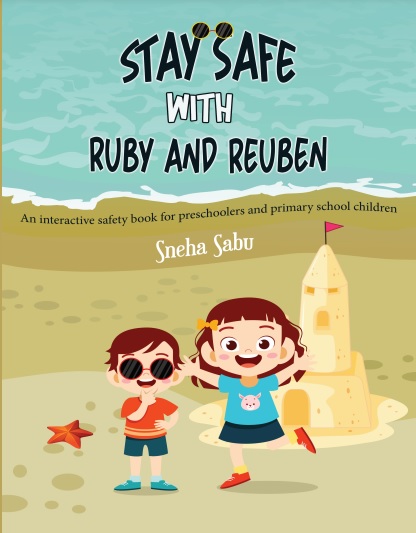
I was lucky to find a wonderful children’s interactive safety book called Stay Safe with Ruby and Reuben. It’s written by the author, Sneha Sabu. She has worked with international NGOs, and has written more than twenty-five stories for children. Her recent release goes over difficult topics to discuss with children, but necessary to maintain safety for them. The book includes the topics of bad and good touches, traveling safe to and from school, safe sleepovers, and secret codes for protection. I was able to have a discussion with Sneha about her favorite reading memories as a child, her favorite author infleunces, and what projects she has in store for us.

  • What is your favorite memory from reading as a child?

Sneha Sabu: As a child, I read comic books. I grew up reading books such as Balarama and Poompatta written in Malayalam, my mother tongue. Even as an adult, I still love reading Balarama. I began reading Nancy Drew, Hardy Boys, and other mysteries as a teenager. Books such as Balarama helped the child in me visualize the unseen animal kingdom on par with the humans. The visual imagery the reading evoked made me an Alice in Wonderland.

  • Who was your favorite author and how did they influence you?

Sneha Sabu: I love J.K. Rowling. Her life demonstrates patience and resilience. I am influenced by what J.K. Rowling achieved as an author in life’s most challenging and uncertain times.

  • Do you have a writing routine? Share what works for you.

Sneha Sabu: I do not have a writing routine. I have my highs and lows in writing. I used to write regularly in the younger years of my career. Over time, with life routine and circumstances changes, I stopped writing for almost a decade. One fine day, I had a very emotional and heartbreaking moment. The situation did not change, but kept recurring in different forms. When I reached a point where I could not bounce back quickly, I decided to write. I wrote day and night until all the stress and emotions were translated into a draft of crime fiction. Ever since, my writing has been revived. I decided to write at least a couple of times a month. That is my new routine. When I have writer’s block, I take a break to have a fresh perspective.

  • What subjects would you like to write about in future projects?

Sneha Sabu: I would like to write in all genres. My book, Stay Safe with Ruby and Reuben, is a child safety book for children. However, I am working on a collection of poems now. In addition, I would like to experiment with motivational books and crime fiction.

  • What is writing to you in one sentence?

Sneha Sabu: Writing is an expression of my creative and exploratory experiments and the things I want to do, influence, and revive from the lost pages of my mind.

Book Blurb For Stay Safe with Ruby and Reuben:

Stay Safe with Ruby and Reuben is an interactive child safety book written to create awareness among children on issues such as good and bad touches, how to be safe in school, how to be safe while going and coming back from school, safe sleepovers and secret codes are critical to protecting children. This book covers the above issues in an easy to read format for children. Profit from sales will be used to fund not for profits working to protect children from child sexual abuse and to print additional copies for children who cannot afford to buy the book.

Stay Safe with Ruby and Reuben is available at Amazon.com.

For more information on Sneha Sabu, please visit her website at snehasabu.com.